You sit down with the journal. Pen ready. The page is blank.
Then the thought you came to settle slips out of reach, splits into three smaller thoughts, doubles back on itself, and starts the loop again. You write a sentence. You cross it out. You start over. Twenty minutes later, the page is half-full of scribbles, your tea is cold, and the storm in your head is louder than when you sat down.
If you're an overthinker, this is familiar. You've been told journaling helps. You've bought the notebook with the soft cover. You've tried "morning pages" and "gratitude lists" and the one with the prompts that rhymed. And every time, the same thing: the act of writing somehow feeds the spinning instead of slowing it.
The fault isn't yours. The standard version of journaling is what keeps letting you down.
Why journaling for overthinking feels harder than it should
Overthinkers don't think in lines. The mind moves fast, branches, doubles back. A single worry pulls in three more before you can finish the first one. Writing demands the opposite: one word at a time, in order, fully formed. So you sit with the page and try to force a fast, non-linear mind through a slow, linear keyhole. The thought has to wait for your hand to catch up. By the time it does, it's already changed shape.
There's a deeper problem, too. The psychologist Susan Nolen-Hoeksema spent her career studying what happens when self-focused thinking goes wrong (Nolen-Hoeksema, 1991). Her research draws a sharp line between two things that look similar from the outside: rumination and reflection. Rumination circles. Same question, no movement. ("Why am I like this? Why can't I just handle it?") Reflection moves toward something. It asks a different question and expects a different answer. ("What is this feeling actually about? What would help right now?")
Free-writing on a blank page can tip overthinkers straight into the first one. You came in to settle the storm. The page just gave it more room to spin.
What actually works: reflection, not venting
The shift has nothing to do with writing more. It comes from changing the shape of what you're doing.
Venting empties. Reflection moves. A vent lays out everything you're feeling and leaves it on the page exactly as it was. A reflection takes the same material and asks it one good question, then another, and another, until the storm has a shape you can actually look at.
The right question is the whole tool. "What's wrong?" keeps you in the loop. "What specifically am I afraid will happen?" steps you out of it. "Why do I feel like this?" is brooding. "What do I actually need right now?" is reflection.
This is why a guided journal, one that asks the next question, does something a blank page can't. It holds the shape for you while you settle. You don't have to organise your thoughts before you put them down. Something else does that part. Your only job is to answer.
How to journal for overthinking: a practical approach
If you've tried journaling before and it didn't stick, try these instead. None of them require a blank page.
- Start with one sentence, not a chapter. The smallest possible entry. "I'm feeling tight in my chest." Done. The bar is on the floor on purpose.
- Use a specific prompt. Specificity breaks loops. A vague invitation ("just write what you feel") opens the door for the spiral. A specific question ("what's the worst thing you think might happen here?") closes it.
- Set a timer. Five minutes. Not "until I feel better", which is open-ended in the same way the page is. Five minutes is enough to surface what's actually there. More than that, and the editing brain steps in.
- Speak it instead of writing it when the loop is bad. Speaking is faster than writing. Faster than the loop. Voice journaling sidesteps the friction entirely.
- Ask "what do I actually need right now?" before anything else. Not what's wrong. Not what you should do. What you need. The answer is usually quieter than you expect.
- Look for the feeling underneath the thought. Overthinkers spend a lot of time examining the surface thought. The thing that actually wants to be heard is usually one layer down.
- When you're going in circles, change the question. If you've answered the same question three times and you're still spinning, the question is wrong. Switch it.
For longer worries that pull you sideways into anxiety, the same logic applies: start specific, stay short, and let the question do the work. (→ Journal Prompts for Anxiety)
Journaling prompts for overthinking that actually move you
These are designed to interrupt the loop, not extend it. Each one is a full sentence you could speak out loud. Pick one. Answer it. Stop there if you want.
- What specifically am I afraid will happen?
- If a friend told me what I just told myself, what would I say to them?
- What is the fear underneath this worry?
- What do I already know about this that I'm pretending not to know?
- What would "good enough" look like here?
- What am I trying to control that isn't mine to control?
- What's the smallest next step I can actually take?
- What would I feel if this thought wasn't here?
- What is this feeling trying to tell me?
- If nothing changed, what would I need to make peace with?
Notice what they have in common. They ask for something specific. They move toward an answer. They don't invite you to circle the same drain again.
Why voice journaling works when writing doesn't
There's a mechanical reason speaking helps overthinkers in a way writing often can't.
Most people speak at around 125 to 150 words a minute, several times faster than they can write the same thoughts by hand. Speech moves at the speed of thought. Writing doesn't. When you try to write a fast, non-linear mind into a slow, linear page, you have to pause and edit and re-form before the thought is fully out. For an overthinker, that pause is exactly where the loop re-enters.
Voice journaling removes that friction entirely. Speaking is continuous: no editing brain in the gap. The thought leaves you before you can second-guess it. By the time you hear it back, it's already settled into something a little clearer than it was inside your head.
That's the part the standard journaling literature misses. For some minds, the act of writing is the obstacle. Voice journaling sidesteps it. The words come out at the speed they formed, not at the speed your hand can transcribe them.
Built for overthinkers. Blank page not required.
This is what Nagi is for.
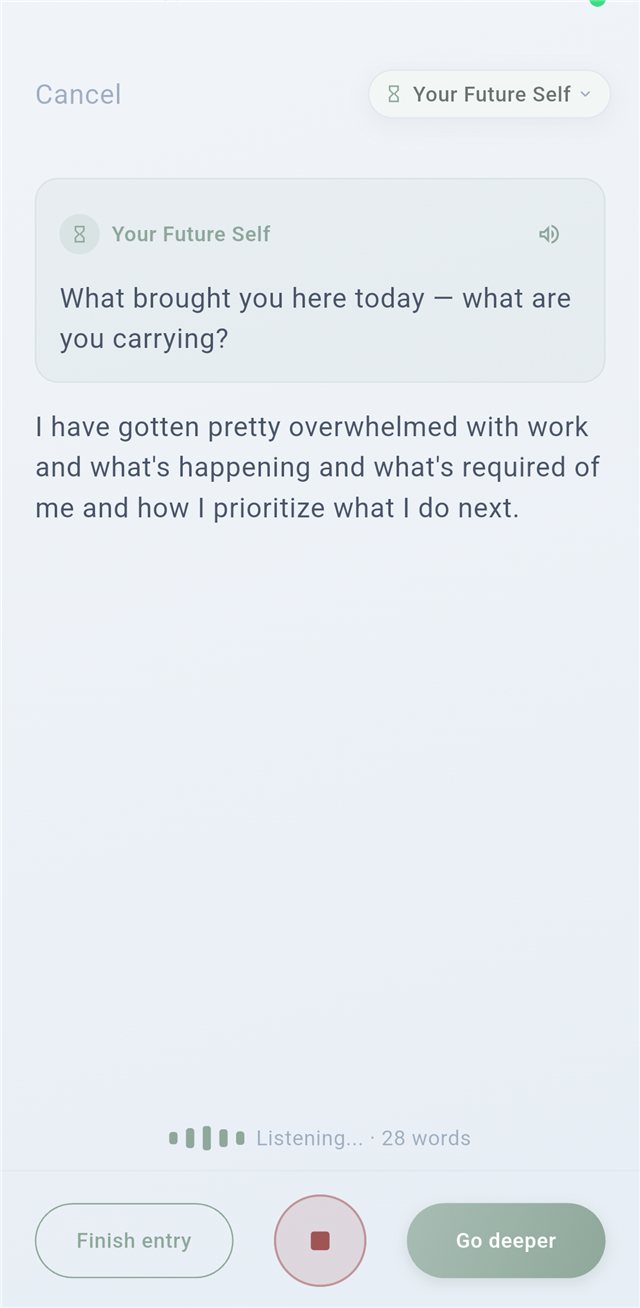
You pick a guide: there are ten, from a grounding Zen voice to a direct Stoic to a quiet companion who just listens. You speak whatever's on your mind. The guide asks the follow-up question that turns a vent into a reflection. The thought you came in with isn't the thought you leave with. The storm has a shape you can finally look at.
No blank page. No prompts you have to come up with yourself. No pressure to write neatly, or quickly, or at all. Just your voice, and a guide who knows the next question to ask.
Frequently Asked Questions
What is the best journal for overthinkers?
The best journal for an overthinker isn't a blank notebook. What works is something that asks the next question. Blank pages invite the spiral because they put the structure on you, which is exactly the part an overthinking mind struggles with. Guided formats work better: one specific question, five minutes, a stopping point. Nagi takes this further by making it voice-first. You speak your thoughts instead of trying to write them down in order. The guide listens and then asks the follow-up that turns a vent into a reflection, so your starting point is a question to answer rather than a blank page to fill.
Why does journaling make overthinking worse?
Because most journaling advice points you at an open page and says "write what you feel." For an overthinker, that rarely brings release. It just invites you to keep going. The psychologist Susan Nolen-Hoeksema drew a clear line between rumination (the same thought, circling) and reflection (purposeful, moving toward something). Free-writing on a blank page often lands in the first category. The fix is structure: a specific question with a built-in stopping point pulls you toward reflection and away from the loop.
Should overthinkers write or speak their thoughts?
Speaking usually works better. Most people speak at around 125 to 150 words a minute, several times faster than they can write the same thoughts by hand. For a fast, non-linear mind, writing requires you to slow down and edit before the thought is out, which is exactly where the loop re-enters. Speaking is faster than the spiral. The thought leaves you before you can second-guess it. Voice journaling captures this: you speak without stopping to revise, hear your own thoughts back, and arrive somewhere clearer than where you started. Nagi is built on exactly this principle.