You pick up a notebook because someone, somewhere, said journaling helps with anxiety. The logic tracks. So you open to a blank page and feel your chest tighten slightly more than it did before you sat down.
That's not a coincidence. And if you've ever wondered how to journal for anxiety without making the spiral worse, you've already found the real question.
An empty page doesn't distinguish between a quiet mind and a racing one. Anxiety fills available space. Open a notebook in front of an anxious brain and it will use every inch of it.
Why journaling for anxiety actually works
Writing about emotional experiences does something measurable to the nervous system. Research by James Pennebaker, who spent several decades studying expressive writing, shows that putting feelings into words reduces the cognitive effort of holding them in. Suppression is physiologically expensive. Your body works to contain what your mind won't release. Externalising a feeling in language, whether spoken or written, lowers that cost. The effect shows up in immune function, blood pressure, and self-reported wellbeing across his published studies.
But the mechanism is specific. Misunderstanding it is exactly how journaling goes wrong for anxious people.
The research shows that the people who benefit most aren't the ones who write the longest entries. They're the ones whose writing moves from scattered fragments toward something coherent: a named fear, a named feeling, a version of events that makes some sort of sense. Constructing, not just venting. That's the distinction that matters.
Venting empties the cup. Constructing asks what's in it and why. Most anxiety journaling advice skips the second step entirely.
The reason journaling can make anxiety worse
There's a difference between sitting with a difficult feeling and being stuck inside it.
Psychologist Susan Nolen-Hoeksema spent years studying what she called rumination: the repetitive, self-focused thinking that keeps an anxious mind circling the same thought without movement or resolution. Her research, with colleagues Wisco and Lyubomirsky, draws a careful line between rumination and reflection. Rumination repeats. Reflection moves. It asks a different question and expects a different answer.
Unstructured free-writing on a blank page tends to feed the first kind. "Write what you feel" is an open invitation with no direction and no stopping point. An anxious brain fills that space exactly the way it fills every other space: with more of the same thought, slightly reorganised, returning to the same weight.
Structure is the antidote. A specific question redirects the mind from rehearsal toward inquiry. You stop circling. You start somewhere.
How to journal for anxiety: a step-by-step approach
These five steps fit in five to ten minutes. You don't need a special notebook. You need a specific question and somewhere to put the answer.
Step 1: Ground before you write
Anxiety lives in the body before it reaches language. Start by locating where the tension is sitting physically. Not "I feel anxious" but "my shoulders are raised, my breath is shallow, there is a tight band across my chest." Name the location and the quality. This is not avoidance: it's an accurate map of where you actually are. The body is a better starting point than the mind when the mind is already running fast.
Step 2: Name the specific fear
Most anxiety hides behind vague threat. "Something bad might happen" is not useful. "I'm afraid that my colleague will raise the project delay at today's meeting and blame me in front of everyone" is specific enough to work with. Write the worst-case scenario as one sentence. Not a paragraph. One sentence. The moment you commit to a single specific sentence, the fear gets smaller. It now has a shape. It wasn't the shapelessness that was so frightening; it was the fact you could not see where it ended.
Step 3: Hold the fear next to the evidence
Take the specific fear and write two things beside it: what evidence supports it, and what evidence argues against it. You are not trying to dismiss the fear or argue yourself out of it. You are trying to see it clearly instead of from inside it. The anxious mind operates in a state of certainty: this bad thing will definitely happen. The evidence exercise is an invitation to be uncertain in both directions.
Step 4: Find the feeling underneath the fear
Anxiety usually sits on top of something else. Worry about a work situation might sit on top of a fear of being seen as unreliable. Worry about a relationship might sit on top of a fear of being left. The surface fear is the presenting complaint. The one underneath it is what actually needs attending to. Write: "This anxiety is trying to protect me from..." and see what comes next.
Step 5: End with one thing, not a plan
Close the session with one specific thing. One action you can take in the next twenty-four hours, or one thing you are prepared to accept if it doesn't change. Not a list. The anxious brain turns a list into more material for spinning. A single point of contact with reality is enough to land the entry somewhere useful.
Journal prompts for anxiety when you don't know where to start
These work as standalone entries. Choose the one that meets you where you are right now.
When the anxiety feels physical:
- Where in my body is this sitting? What does it feel like: tight, hollow, heavy, electric?
- If I softened just one muscle group right now, which one would it be?
When the fear is blurry:
- What, exactly, am I afraid will happen? Write it as a sentence, not a feeling.
- How likely is this outcome, honestly, if I look at it without the anxiety's certainty?
When you're in the middle of the spiral:
- What do I already know about this that I keep forgetting?
- What would I say to a close friend who brought me this exact worry?
When you need a stopping point:
- What does the worried part of me actually need right now: reassurance, rest, a plan, or company?
- What is one thing I can do in the next hour, not to fix this, but to be less harsh with myself while it's here?
For more structured prompts, organised by what your anxious mind is doing in the moment, see our piece on journal prompts for anxiety.
When speaking your anxiety out loud works better than writing it
Some anxious moments resist the page. The hand is too slow. The thought changes before the sentence finishes. The part of your brain that edits steps in and sands off what was raw.
Speaking works differently. The thought leaves your body before you can rework it. That's not carelessness. It's the mechanism.
When anxiety is at its most physical, the shallow breath and the tight chest and the thoughts that blur together, speaking out loud often moves through the spiral faster than any notebook. You don't have to be sitting down. You don't have to be still. A voice note to yourself, a brief spoken brain dump while pacing your kitchen, speaking into an app that listens and asks the next question: all of these bypass the friction that writing adds when anxiety is already high.
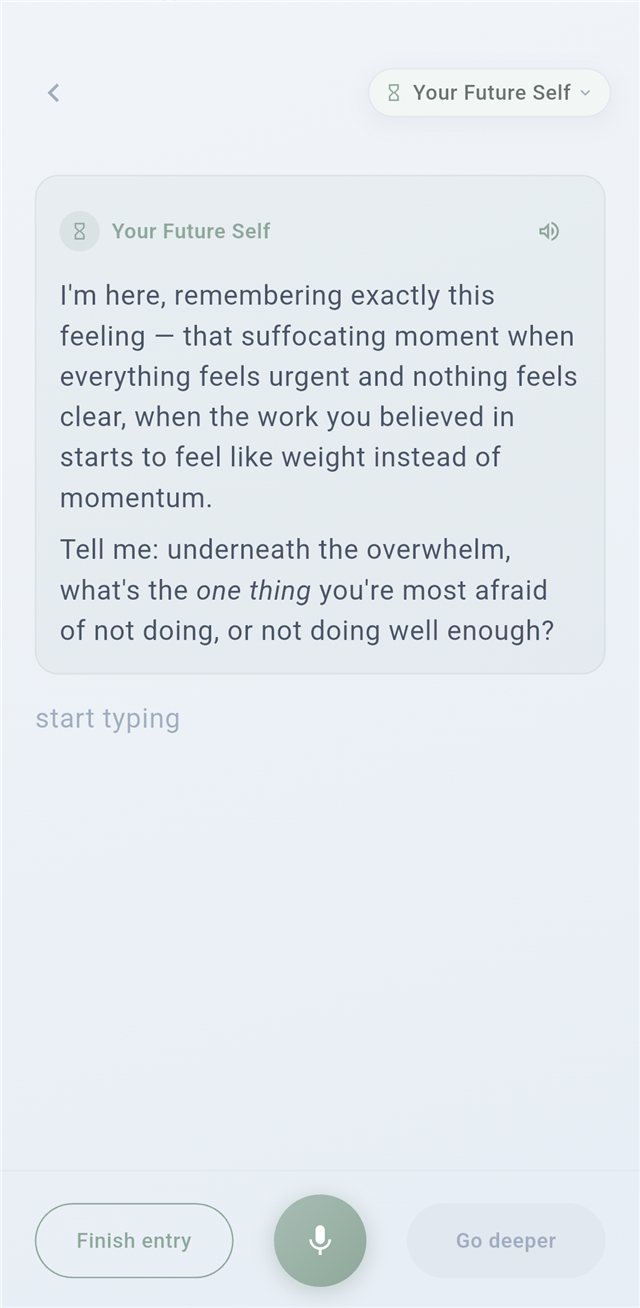
This is what Nagi is built for. You pick a guide, a calm one or a direct one, whichever fits the day, and you speak whatever is on your mind. The guide asks the follow-up question your own mind wouldn't have thought to ask. The five steps above become a conversation instead of a solitary exercise. The spiral doesn't get to circle forever.
If the blank page has never felt like relief, it might not be that journaling doesn't work for you. It might just be writing.
If your anxiety tends to arrive when you're thinking in circles rather than when you're overwhelmed by a specific fear, the approaches in our piece on journaling for overthinkers may be a better fit.
Frequently Asked Questions
What should I write in my journal when I'm anxious?
Start with the body first, not the feelings. Write where the anxiety is sitting physically and what it feels like: tight, hollow, heavy, electric. That physical grounding interrupts the cognitive loop before it can deepen. Then move to one specific question: "What, exactly, am I afraid will happen?" One question, five minutes, a stopping point built in. If writing still feels like a wall when anxiety is high, try speaking instead. That is exactly what Nagi is built for.
How often should I journal for anxiety?
Consistency matters more than frequency. Two or three times a week builds the reflex of externalising rather than suppressing. You are not trying to clear every anxious thought in one session. You are training a habit, over time, of moving from spiral to stillness. Daily journaling is fine if it fits your life; forced daily journaling becomes its own source of pressure.
Can journaling make anxiety worse?
Yes, under specific conditions. Unstructured free-writing about a worry can deepen rumination rather than release it. Research by Nolen-Hoeksema and colleagues distinguishes between rumination, which circles the same thought without progress, and reflection, which moves toward a new answer. Unstructured self-focus feeds the first kind. The fix is a specific prompt with a built-in stopping point. If you're five minutes in and your chest is tighter, not looser, switch to a grounding prompt or stop entirely. The session is meant to serve you.