You bought the notebook. Maybe you used it for a week, then two weeks, then one morning the words didn't come and the blank page sat there like a question you couldn't answer. Something about starting from scratch felt harder than just thinking. So the notebook went on the shelf.
If you're wondering how to start journaling in a way that actually sticks, that's not a failure of willpower. It's a failure of method. The blank page approach is what most people are taught, and it's one of the least effective ways to begin. The practice itself works. What breaks it is starting with nothing and hoping for something to arrive.
This is what the research shows, and what most journaling guides leave out.
Why How to Start Journaling Keeps Feeling Impossible
The instruction "just write what you feel" contains a hidden assumption: that you already know what you feel before you start. Most people don't. Feelings arrive as a vague tightness, a background noise, a half-formed worry that scatters the moment you try to look at it directly.
So you sit with the blank page and attempt to name something that hasn't finished forming yet. The pen stays down. Five minutes pass. You write "I feel..." and stop. You close the notebook.
There's a reason this pattern repeats. Psychologist Susan Nolen-Hoeksema spent years studying what happens when self-focused thinking goes wrong. Her research draws a clear line between rumination, the same thought returning without going anywhere, and reflection, which moves toward something new: a different angle, a feeling underneath the surface feeling, a small piece of clarity. A blank page with no direction tends to invite the first. You weren't failing at journaling. You were handed the wrong tool.
The fix isn't more discipline. It's a different starting point.
What Writing About Your Feelings Actually Does
James Pennebaker's expressive writing research, developed over more than three decades and replicated across more than 100 studies, found a consistent result: when people write or speak about emotional experiences in a structured way, they show measurable improvements in wellbeing. The mechanism is specific. Holding a difficult thought without expressing it is physiologically costly. Getting it outside your head, where you can observe it rather than be inside it, reduces that load.
The key word is "structured." A random outpouring of worries is less useful than asking one specific question and following it somewhere. Venting releases pressure; reflection goes somewhere with it.
Most people notice a shift after two to four weeks of consistent practice. The shift is a loosening, not a transformation. The thought that kept interrupting starts to feel less urgent, not because it's been solved, but because it's been seen.
How to Start Journaling When You Have Nothing to Write
This is the most common stuck point, and it deserves its own section. You sit down, and there is genuinely nothing there. Or everything is there, in a fog, and you can't find the edge of it.
Start smaller than you think you need to.
Not "describe your day." Not "write about what's on your mind." Try one question, small enough to actually answer: "What is one thing I'm carrying right now that I haven't said out loud?"
That's the entry point: one specific question, not an open invitation to write whatever comes. If the answer is "nothing, I'm fine," write that. "I'm fine" is data. Notice what comes after it.
If you have something but can't find the start of it, speak it first. Out loud, before you write anything down. Say the worry once, in the messiest form it takes in your head. You're not performing for anyone. You're locating the thing. Then write down what came out.
The voice is faster than the pen. It's harder to overthink when you're already talking.
Five Things That Work Better Than the Blank Page
These are not tips for being more disciplined. They're different mechanics for a different starting point.
Start with one specific question. Not "how are you feeling today?" but "what specifically is sitting on my chest right now?" Vague invitations open the door for the spiral. A concrete question cuts through it.
Give yourself a time limit. Five minutes. Not "until I feel better," which is open-ended in the same way the blank page is. Set the timer. Stop when it ends. The entry doesn't need to be finished. It needs to exist.
Lower the bar for what counts as an entry. Three sentences is a journal entry. One sentence is a journal entry. "I don't know what to write but something feels off and I think it has to do with the meeting I can't stop replaying" is a journal entry. Whatever it is, it counts.
Switch to speaking when writing stalls. If you've been sitting with the page for two minutes without writing, try speaking instead. Record a voice note. The spoken version of the thought is almost always clearer than the written version that didn't arrive.
Don't aim to resolve anything. A session doesn't need a conclusion. It just needs to move the thought from inside to outside. Resolution can happen later, on its own. The session's only job is the externalisation.
Why Voice Journaling Removes the Wall
Some minds aren't built for writing. That's not a character flaw. It's a mismatch between the tool and the way the thought forms.
For someone who processes by speaking, sitting down to write forces a translation step: thought into language into written words. Each step introduces a pause. In the pause, for an anxious or busy brain, the editing starts. You change the sentence before it's finished. You cross out the honest version and write the careful one. You end up with something tidy that isn't quite true.
Speaking removes the translation. The thought leaves you as it formed. The mess is the point. In a voice journal, you don't need to find the right sentence. You say the wrong one, then the next thing, and eventually the thought has landed somewhere outside you where you can actually see it.
That's the mechanism. It's a specific property of speaking out loud before the internal editor catches up.
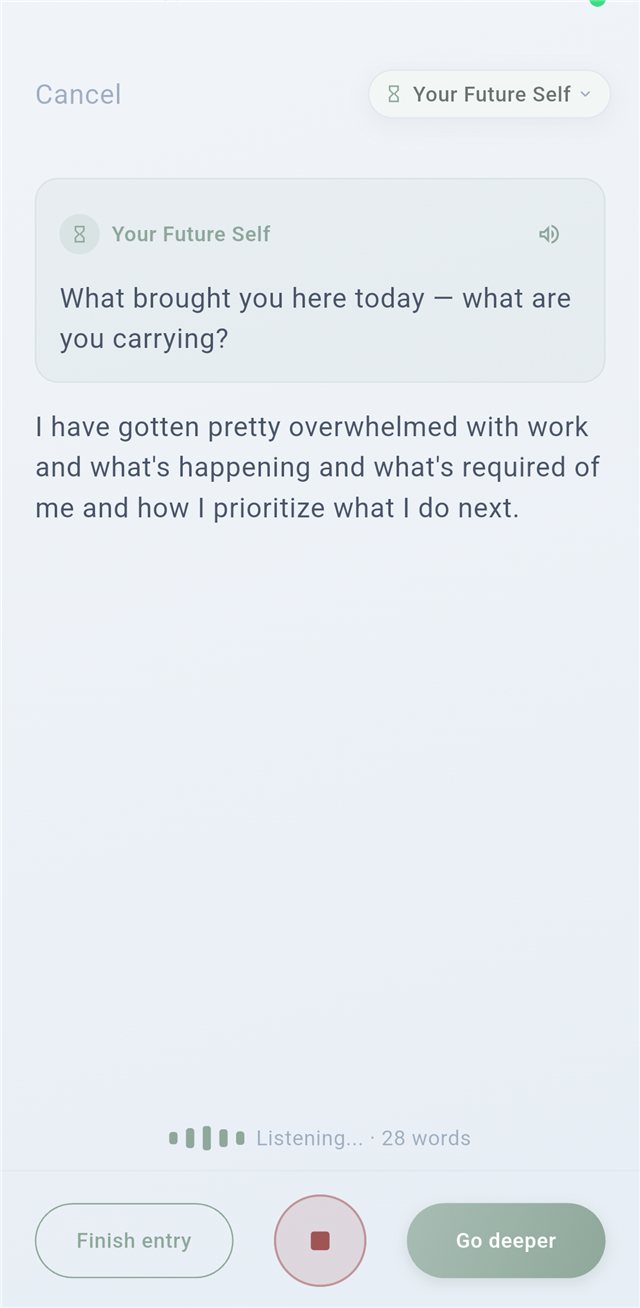
This is what Nagi is built for. You pick a guide: ten options, from a grounding Zen voice to a direct Stoic to something closer to a calm friend who asks the question you keep avoiding. You speak. The guide listens, then asks the follow-up your blank journal couldn't have offered. You arrive somewhere different from where you started. Not because you followed a structure, but because the right question arrived at the right moment.
No blank page. No pressure to write neatly or write at all. Just your voice and somewhere to put what's in your head.
Eight Prompts to Start With Right Now
These work for first attempts and for anyone returning to journaling after the notebook went on the shelf. Pick one. Just one. Answer it in whatever form comes first, written or spoken.
- What is one thing I'm carrying right now that I haven't said to anyone?
- If I wrote down exactly what I'm afraid of, what would it say?
- What happened recently that I'm still turning over in my head, and why?
- What would I say to a close friend who came to me feeling what I'm feeling right now?
- If this feeling is trying to tell me something, what might it be?
- What is the smallest possible version of a good day tomorrow?
- What am I pretending is fine when it isn't?
- What would I do differently here if I wasn't afraid?
Notice what these have in common. None of them ask you to know how you feel before you start. They create the conditions for the feeling to show up on its own.
For longer worries that pull into anxiety, the same logic applies: start specific, stay short, let the question do the work. (Journal Prompts for Anxiety)
Frequently Asked Questions
Why do I always quit when I try to start journaling?
The most common reason isn't lack of discipline. It's starting with a blank page and no structure. Free-writing about your thoughts can lead to replaying them rather than processing them. Psychologist Susan Nolen-Hoeksema's research on rumination draws a clear line between the same thought circling without progress and the kind of reflection that actually moves somewhere. A blank page with no direction tends to produce the first. The fix is one specific starting prompt rather than an open invitation to write whatever comes. See also: Journal for Overthinkers.
How do I start journaling when I have nothing to write?
When the page is blank and the mind feels empty, or too full to locate, shrink the target. Instead of "write about your day," try one specific question: "What is one thing I'm carrying right now that I haven't said out loud?" If writing still stalls, speak it first. Say the worry in its messiest form out loud, then write what came out. The spoken version of a thought is almost always clearer than the written version that didn't arrive. Voice journaling removes the translation step entirely, so the thought lands before the editing brain can intercept it.
How long does it take for journaling to work?
Based on the direction of James Pennebaker's expressive writing research, replicated across more than 100 studies, most people notice a shift after two to four weeks of consistent practice. Not a transformation: a loosening. The thought that kept interrupting starts to feel less urgent, not because it's resolved, but because it's been externalised. Consistent here means two or three times a week, not daily perfection. Starting with five minutes and one prompt is enough. The habit breaks when the starting bar is set too high.