Someone told you to try journaling for depression. A therapist, maybe. Or an article you found at 11pm. You located the notebook you bought a few months earlier with good intentions. You opened it to the first page and wrote the date.
Then you wrote: I feel really low today.
Then you stopped. Not because you had nothing to say, but because the thought arrived: what's the point? You crossed the line out. You tried another: something about being tired, about not being able to sleep. You crossed that out too. The notebook went back on the shelf. Two sentences, and the session had somehow managed to feel like one more thing you couldn't do.
The intervention that genuinely helps anxiety and overthinking runs into specific obstacles when depression is the condition. Low energy makes the friction of writing feel enormous. The self-critical inner voice that accompanies depression often gets louder on the page, not quieter. And the blank journal can become a record of all the days you couldn't manage it, rather than a tool that might help.
That doesn't mean journaling doesn't help with depression. Research says it does. It means the version that helps looks different from morning pages or gratitude lists.
Why journaling for depression is harder than most guides suggest
Depression flattens the will to begin. Getting out of bed costs something. Sitting down with a notebook, finding a pen, uncapping it, forming coherent sentences: each small step costs more.
There's a second barrier specific to depression: the inner critic. Writing one sentence and immediately finding it wrong. Starting a paragraph and deleting it mentally before the second line arrives. The blank page, instead of being a neutral surface, becomes a mirror for that critic. Nothing you put down is right. And the writing session ends up feeling like more evidence of the problem, not a way through it.
There's a third barrier: the cumulative weight of missed entries. Journaling is often framed as a daily habit. Habits require consistency. Consistency is one of the first things depression takes from you. The pages pile up unmarked, and now the journal is also a record of the days you couldn't manage.
None of this means the evidence for journaling is wrong. It means you need a different entry point than the one most advice suggests.
What the research on journaling for depression actually shows
James Pennebaker's research on expressive writing, built across more than thirty years at the University of Texas, finds that putting emotional experiences into words produces measurable benefits across physical and psychological health. But the mechanism that matters is not the act of writing itself. It is what the writing does.
The people who benefit most from expressive writing are not those who describe how bad they feel. They are the ones whose writing moves, over multiple sessions, from symptom description toward understanding and narrative coherence: why this is happening, what it connects to, what might come next. That shift is where the benefit lives.
A 2023 study published in Behaviour Change (Cambridge University Press) tracked participants through a journaling app programme and found that psychological wellbeing improved only among those with at least average baseline levels of self-reflection. The reflective quality someone brings to the writing shapes what the writing does.
This is where the risk sits for depression. Research by Nolen-Hoeksema, Wisco and Lyubomirsky found that rumination, defined as repetitively focusing on the symptoms and consequences of low mood, prolongs that mood and impairs problem-solving. An open page with the instruction "write about how you feel" is, for some people with depression, an invitation to do exactly that.
The question is not whether to journal. It is what to do with the page.
What journaling for depression actually looks like when it helps
Short sessions. Not twenty minutes. Five. The goal is not to process everything in one sitting. It is to get something outside your head and observe it from a slight distance.
Prompts, not open pages. Depression doesn't generate its own structure, and asking it to is unfair. A blank page puts all the architecture on you, which is exactly the capacity depression diminishes. A specific question does that work instead. Your only job is to answer it.
Writing that moves toward something. The prompts that help push from feeling toward pattern, from symptom toward context, from self-criticism toward something closer to curiosity. "What's been weighing on me most today, and what was one small thing that helped?" is structurally different from "write about how you feel." Both start in the same place. Only one moves.
Tolerance for bad entries. Some sessions will be half a sentence. Some will be a list. Some will be a question you can't answer. That is fine. The research on expressive writing does not require brilliant prose. It requires the act of putting something outside your head.
And when writing is too much: speaking. At the bottom of a depressive episode, the physical act of writing can become its own wall. Forming letters, finding words, holding the pen. Speaking is lower effort. You can do it from wherever you are, without a notebook you can't remember where you put.
Journaling prompts for depression to try right now
Pick one. Just one. Answer it as briefly or as fully as you need. Stop when you're done.
- What's been weighing on me most today? Just one thing.
- If I could identify the feeling underneath the heaviness, what would I call it?
- What have I been telling myself about myself lately? Is any of it actually true?
- When did I last feel even slightly more like myself? What was different that day?
- Where in my body does this weight sit right now? What would it feel like to loosen it by ten percent?
- What would I say to a close friend who was feeling exactly this?
- What do I actually need today: rest, company, quiet, movement, permission to stop?
- What's one small thing that helped a little today, even if it only helped for ten minutes?
Notice the shape of them. They are specific. They redirect toward something other than the symptom. And they have a built-in stopping point: a single answer, not an open chapter.
When the blank page keeps losing
Sometimes writing isn't the right tool. Not because journaling is wrong for depression, but because the friction of starting is higher than the available energy.
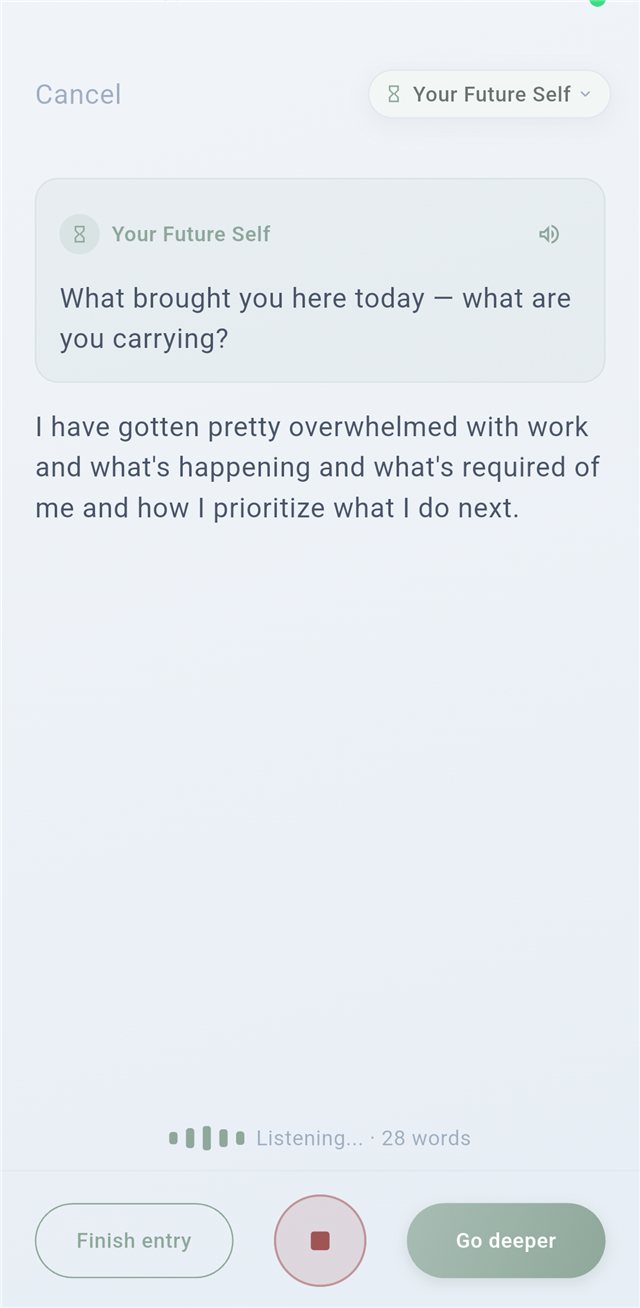
This is what Nagi is built for. Voice journaling, speaking out loud instead of writing, removes the blank page entirely. You pick a guide from ten options: a grounding companion, a challenging voice, a quiet listener. You speak whatever comes. The guide asks the follow-up question. You don't have to hold the shape of the session yourself; the conversation does that for you.
For depression specifically, this changes the friction equation. The guide holds the structure when you can't. The words don't need to be spelled correctly or formed into full sentences on the first try. You can speak from a dark room or a walk or the couch, and start without opening anything.
The aim isn't to fix anything. It is to get the weight outside you, even slightly, and look at it from two inches of distance. That distance is where something can shift.
If anxiety sits alongside the low mood, the approach is similar but the prompts differ. (Journal prompts for anxiety covers that specific state.)
Frequently Asked Questions
Can journaling make depression worse?
Yes, under specific conditions. Open-ended writing about how low you feel, how exhausted you are, can function as rumination rather than reflection. Research by Nolen-Hoeksema, Wisco and Lyubomirsky found that rumination, defined as repetitively focusing on the consequences of low mood, prolongs that mood and impairs problem-solving. An open page with no direction makes this easy to fall into. The fix is structure: a specific prompt that moves toward understanding or self-compassion redirects the mind from circular symptom rehearsal toward something purposeful. If you are five minutes in and heavier than when you started, stop or switch prompts. The session is meant to serve you.
What's the best way to journal for depression?
Short sessions with specific prompts. Five to ten minutes, one question, written toward understanding rather than symptom description. Research on expressive writing is clear: writing that moves toward narrative coherence and meaning produces better outcomes than writing that catalogues distress. When writing is too much effort, speaking the answer out loud works just as well. Voice journaling removes the friction of forming words on a page, which is often what stops a session from starting at all.
How is journaling for depression different from therapy?
Journaling is a practice for self-reflection and self-understanding. Therapy is clinical care from a trained professional. They are not substitutes for each other. Journaling can support a therapeutic process: between sessions, as a space to notice patterns and put difficult thoughts outside your head. It is not a replacement for clinical assessment or treatment of depression. If your symptoms are severe, persistent, or affecting your ability to function day to day, speaking with a doctor or therapist is the right step.