The thought had been there for hours. Swirling, not settling.
You open a notes app. Or a journal. Or the voice memo app you keep meaning to use. You sit there for a second. The thought, the one that's been pulling at your attention all day, goes quiet. Three other thoughts arrive immediately. You notice something on your phone. You remember something completely unrelated. Then the original thought is gone.
The journal is still blank.
That is ADHD journaling, in miniature. And the problem isn't that you're bad at reflecting. The problem is structural. It starts with the blank page, and the blank page was never designed for your brain.
The blank page is a cold start, and ADHD hates cold starts
ADHD brains don't struggle with everything equally. What they struggle with, consistently, is starting tasks that provide no immediate structure or external feedback.
The blank page offers neither. There's no first question to answer, no prompt to react to, no external cue to get started. Just white space and the quiet expectation that you'll know what to do with it.
Psychologist Russell Barkley, whose decades of research have shaped how ADHD is understood clinically, describes the condition as fundamentally a disorder of executive function: specifically the brain's capacity to self-regulate toward a goal when there are no external cues providing structure. The blank page is the hardest possible test of that capacity. It asks you to generate your own structure, from nothing, with no reward in sight. That's not a warm-up. That's the event.
This is why good intentions don't survive contact with a blank page. It isn't resistance. It's the same mechanism that makes you stand in the kitchen for two minutes doing nothing, even when you're hungry. The action you want to take has no on-ramp, so the brain doesn't get moving.
Writing makes the problem worse
Even if you push through the cold start and get something onto the page, writing creates a second problem.
The average person writes about 15 words per minute by hand. ADHD thinking is fast and associative: one thought spawns three more before you've finished the first sentence. By the time your hand catches up, the original thought has split, mutated, and become harder to hold.
Working memory is part of this. ADHD strongly affects working memory, the brain's ability to hold information in mind while doing something else with it. In practice, the thought you were about to write disappears in the gap between forming it and putting it down. You're left with the feeling of having had the idea, but not the idea itself. What ends up on the page is a reconstruction. A paler version of what was actually there.
The editing brain compounds it. Writing requires producing words in order, in a form worth keeping. That slows output to the point where self-censorship kicks in before the thought is even fully formed. The honest, messy version gets filtered into something more presentable. Which is almost always less true.
What actually works for ADHD journaling
The solution isn't trying harder. It's removing the conditions that make starting and sustaining impossible.
Start with a specific prompt. Structure replaces the cold start. One question with a real answer is everything the blank page isn't. "What's been pulling at my attention today?" gets you moving. "Write about how you feel" does not. For ADHD brains that also spiral into overthinking, the journal for overthinkers has prompts built for exactly that pattern: specific enough to cut through, not so open that they invite more circling.
Make the session short. Not "as long as you need." Five minutes. The ADHD brain can almost always find five minutes. A fixed limit removes the dread of open-ended commitment. You're not sitting down to excavate your entire inner life. You're answering one question for five minutes, and then you're done. Counterintuitively, the limit often produces more honest output. There's no time to edit yourself into something presentable.
Remove the blank page entirely. This one is obvious once you say it out loud. If the blank page is the structural problem, the answer is: don't start with one.
Why speaking works when writing doesn't
Voice removes every friction point that writing creates for an ADHD brain.
Speaking is fast enough to match how ADHD thinking actually moves. There's no gap between forming a thought and getting it out. The thought that would have evaporated in the space between thinking and writing lands before working memory can lose it. There's no editing brain in that gap. No hand that can't keep up.
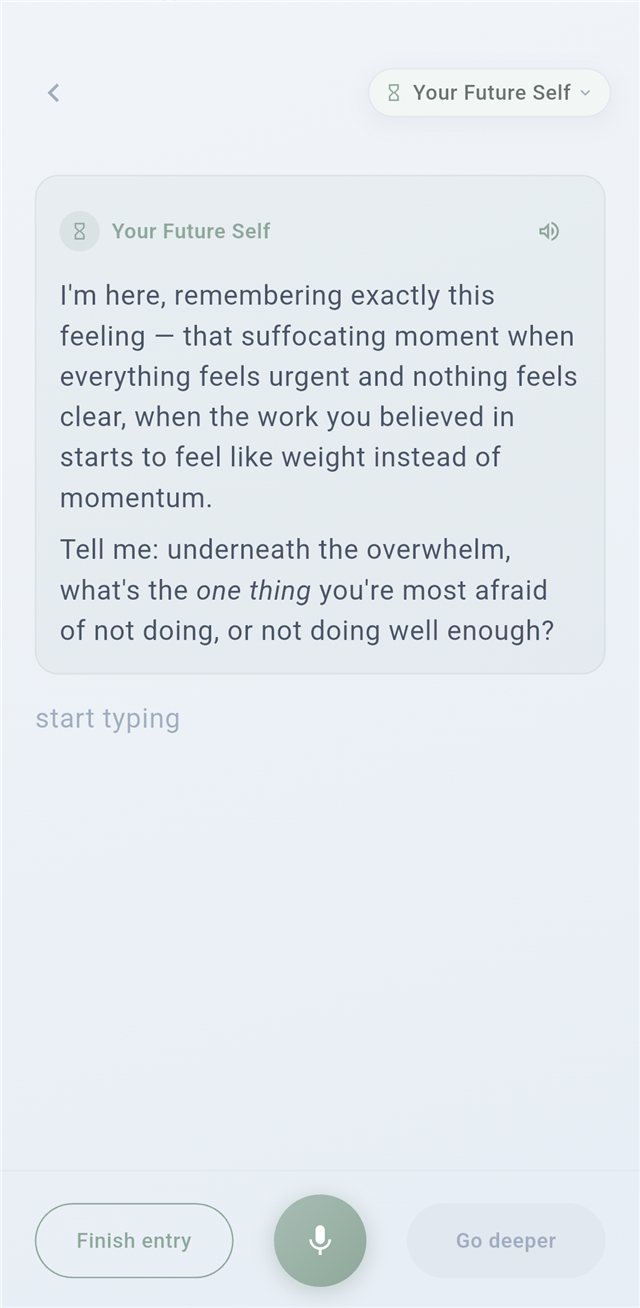
Speaking also removes the cold start. You're not beginning from nothing; you're responding to a question. Responding is something ADHD brains do readily. It's the self-generated starting from scratch that locks things up.
There's substantial research on why externalising thoughts helps when the mind is overwhelmed. James Pennebaker's four decades of expressive disclosure research show that putting feelings into language reduces the cognitive cost of suppressing them. The brain stops spending energy containing what it can now see. Speaking achieves the same effect, with far less friction, for brains that find writing a barrier. If anxiety runs alongside the ADHD (which it often does), journal prompts for anxiety work just as well spoken aloud as written down.
When a guide asks the next question, your only job is to respond. Not to generate the structure. Not to decide what to write about next. Just to answer what's in front of you. That's what makes it stick where a blank page never did.
A note on ADHD journaling and consistency
If you've started a journal three times and stopped three times, that isn't failure. That's what happens when the format doesn't fit the brain.
Journaling consistency with ADHD usually comes from one thing: reducing friction to almost nothing. The session has to be short enough that starting it doesn't feel like a commitment. The format has to give you something to react to. And speaking, which requires no staring at a page, no hand cramp, no forcing fast thoughts through slow lines, is often the only format ADHD brains can sustain long enough for it to mean something.
The blank page was never the right tool for your brain. That's the problem. Not you.
Frequently Asked Questions
Why can't people with ADHD keep a journal?
The blank page requires the ADHD brain to generate its own structure from nothing: no prompt to react to, no external cue to get started. For a brain that struggles with task initiation without structure, that's the hardest possible starting point. Most people with ADHD don't fail at journaling because they don't care about reflection. They fail because the format asks for a skill ADHD makes really hard. Shorter sessions with specific ADHD journal prompts, or speaking instead of writing, remove most of what makes it fail.
What is the best journaling method for ADHD?
The format that works has three things in common: a specific starting prompt rather than a blank page, a short fixed time limit (five minutes is usually enough), and as little friction as possible between the thought and getting it out. Voice journaling tends to work better than written journaling for ADHD because it removes the speed mismatch between fast associative thinking and slow handwriting, and eliminates the working memory gap where thoughts get lost before they reach the page.
Does journaling help ADHD symptoms?
Journaling doesn't address the neurological basis of ADHD, but it can really help with some of what ADHD makes harder. Externalising thoughts, getting them out of your head and into something you can look at, reduces the cognitive load of holding them in working memory. Pennebaker's research, replicated across more than 100 studies, shows that putting feelings into language decreases the mental effort of suppression. For ADHD brains that carry a lot at once, that relief is real. The format has to be right, though. A blank page tends to do the opposite.
How long should an ADHD journaling session be?
Five minutes is the right starting point. Long enough to get somewhere; short enough that the ADHD brain doesn't dread beginning it. Open-ended sessions ("journal for as long as you need") are harder to start because the commitment feels unbounded. A fixed five-minute limit removes that dread and, counterintuitively, often produces more honest output because there's no time to edit. Once the habit is established, longer sessions happen naturally on days when they're needed.
Is voice journaling good for ADHD?
Voice journaling addresses the two biggest failure points of written journaling for ADHD. Speaking is fast, close to the speed of thought, so the working memory gap disappears. The thought gets out before the brain moves on. And speaking into a prompt or a guide removes the cold start. You're responding rather than generating from nothing, which is far more accessible for an ADHD brain. Many people with ADHD who have never kept a consistent journal find voice journaling sticks in a way writing never did.