You write three sentences. You close the notebook. Nothing feels different.
That's the experience most people have with journaling. Not because they're doing something wrong, and not because they have nothing to say. They're just not doing reflective journaling.
Reflective journaling is the practice of writing (or speaking) in a way that generates insight rather than just records experience. The difference comes down to one move: after describing what happened and how you felt, you ask what it means. That third step is where the storm begins to settle.
How reflective journaling differs from regular journaling
Regular journaling: what happened, how I felt.
Reflective journaling adds a third thing: what does it mean?
A diary entry describes the day. A reflective entry examines it. The first is a transcript; the second is a conversation you're having with yourself about the transcript. The goal of reflective journaling isn't documentation. It's to arrive somewhere you weren't when you sat down.
This is why the blank page so often falls short. It has no mechanism for that third move. You write what happened. You write how you felt. Then the page waits. Nothing asks what it means. The thought sits where it was, dressed in slightly neater handwriting.
The blank page invites expression. Reflective journaling requires direction.
Why reflective journaling works
James Pennebaker at the University of Texas has spent four decades studying what happens when people write about emotionally meaningful experiences. His research, tested across more than 100 studies, finds a consistent result: putting feelings into language reduces the cognitive and physiological load of holding them in. The brain stops working so hard to suppress what it can now see.
But not all journaling produces this effect equally. What predicts benefit is the quality of engagement. Writing that moves toward making sense of an experience, that builds a shape for the feeling rather than rehearsing it, produces larger gains. Depth of engagement matters. That's the engine of reflective journaling: not more words, but purposeful movement.
The contrast with rumination matters here. Psychologists studying the difference between rumination (the same thought circling, no movement) and reflection (purposeful movement toward meaning) consistently find that unstructured writing about worries can feed the first rather than produce the second. The page becomes another room for the same thoughts to pace in. Structure is what changes that. A question with a direction. A stopping point built in. Something that asks what the feeling means before you go looking for another page to fill.
How to actually do reflective journaling
The shift from journaling to reflective journaling isn't a matter of effort. It's a matter of questions.
Where regular journaling invites you to express, reflective journaling asks you to interpret. Specific questions are the tool. Vague prompts ("how do you feel today?") invite description. Pointed ones ("what specifically unsettles you about what happened, and what does that say about what you actually need?") push you past description into something you can use.
A few practical shifts that change everything:
- Write about what happened in one sentence. Then move. The event is the starting point, not the subject.
- Use a question that has somewhere to go. "I feel bad" is an answer. "What specifically am I most afraid will happen here?" is a reflective move.
- Look for the feeling underneath the first feeling. The one you wrote down first is often the presenting emotion. The one under it is usually what wants attention.
- Ask what you actually need, not what you should do. These are different. The second one is where overthinking starts.
- Stop before you've written yourself into a circle. Ten minutes is enough. More than that, and the editing brain takes over.
Reflective journaling prompts that actually move
These are designed to shift you from description to interpretation. Pick one. Answer it. That's the session.
- What specifically am I carrying today that I haven't put down yet?
- What is this feeling, underneath the surface version of it, actually trying to tell me?
- If I gave myself the advice I'd give a close friend in exactly this situation, what would I say?
- What am I pretending isn't bothering me?
- What would settling this actually look like, in concrete terms?
- What's the thing underneath the thing I said out loud?
- If this feeling were allowed to stay without being fixed, what would change?
- What do I actually need right now, not what I think I should do?
Notice what these have in common. None of them ask you to feel better. They ask you to understand better. The relief is a consequence, not the goal.
If anxiety is what brought you to journaling, these prompts work in the same direction: journal prompts for anxiety that cut through rather than circle.
When reflective journaling feels hardest
The moments when reflective journaling is most needed are often the moments when writing feels most impossible.
When you're overwhelmed, sitting still with a page requires a kind of composure the state actively prevents. When you're ruminating, writing can extend the loop rather than break it. When you're carrying something you haven't named yet, the blank page offers no way in.
This isn't a character flaw. It's a mismatch between the tool and the moment.
Speaking often gets there faster. People speak at around 125 to 150 words a minute, several times faster than handwriting moves. For a mind already running fast, writing requires slowing down and revising before the thought is fully formed. That's exactly where the internal editor steps in. And the internal editor is very good at making your feelings sound contained and sensible, which is precisely what reflective journaling is trying to get underneath.
Speaking your reflection out loud, without stopping to correct or organise, catches the thought before it's been tidied. The pauses and the repetitions and the places where your voice changes register are part of the material. They carry what the written sentence smooths away.
For overthinkers especially, the friction of writing can turn reflection into revision. How a journal built for overthinkers works differently comes down to the same principle: the question, not the page, does the work.
How Nagi supports reflective journaling
This is what Nagi is built for.
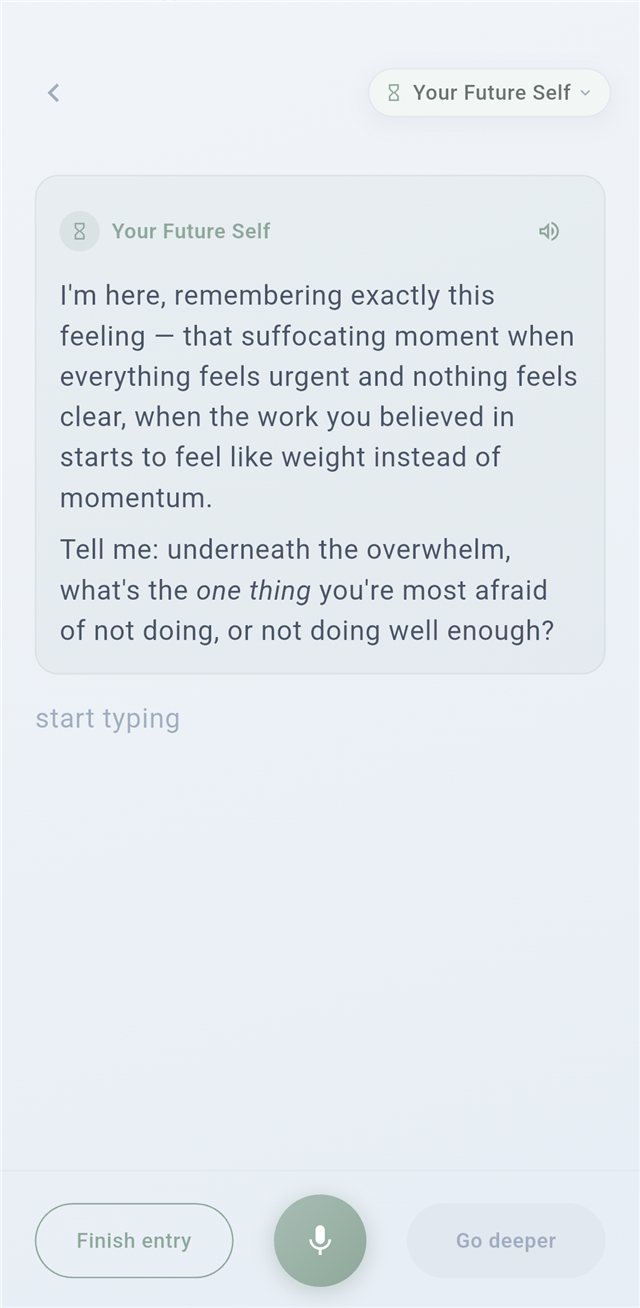
You pick a guide: ten options, from a grounding Zen companion to a direct Stoic to a compassionate listener who just holds space. You speak whatever's on your mind. The guide asks the follow-up question: the one that moves you past description and into meaning. That's the reflective move, and it's the part a blank page can't provide.
Most journaling tells you to reflect. Nagi asks what you think, then asks again. The storm settles differently when something holds the question open.
Frequently Asked Questions
What is reflective journaling?
Reflective journaling is the practice of writing (or speaking) in a way that generates insight rather than just records experience. The difference from regular journaling is the third move: not just what happened and how you felt, but what it means. Structured questions that ask "why" or "what do I actually need right now?" are the tool. The goal is to arrive somewhere different from where you started, a little clearer, a little less held by whatever you came in carrying.
What is the difference between journaling and reflective journaling?
Regular journaling documents. Reflective journaling interprets. A diary entry describes the day; a reflective entry examines it. The practical difference is in the questions you ask yourself. "I felt upset" is documentation. "What specifically upset me, and what does that say about what I need right now?" is reflection. Most journaling advice doesn't distinguish between the two, which is why many people journal for months without getting much insight from it.
Can I do reflective journaling by speaking instead of writing?
Yes, and for many people it works better. Writing requires you to slow down and revise before the thought is fully formed, which can flatten exactly the feeling you came to examine. Speaking allows the thought to arrive before the internal editor steps in. Voice journaling, especially with a guide that asks the follow-up question, is one of the most effective forms of reflective practice, and it requires no blank page.