Voice journaling is the practice of speaking your thoughts aloud instead of writing them down. You press record, or simply speak, and say whatever's on your mind, raw and unstructured. The words come out at the speed they formed. The page stays blank. The storm clears.
It's the oldest form of processing there is, talking through what's troubling you, given a structure and a record.
How Voice Journaling Works
A session requires nothing more than a phone and a few minutes. You speak into a voice memo app, a dedicated journaling tool, or into the air if you'd rather not record at all. You say what's on your mind. You stop when you feel clearer.
What separates voice journaling from a voice memo is intention. Without a question to answer, sessions tend to circle the problem without moving through it. You describe the worry, hear it back, feel slightly worse. The venting goes nowhere.
The difference is structure. The most effective voice journaling gives you something specific to respond to: a prompt, or a guide who asks what you wouldn't think to ask yourself. That one question changes everything. It's what turns a vent into a reflection.
The Science Behind Speaking Your Thoughts
The evidence for putting emotional experience into language is one of the most consistent findings in psychology. James Pennebaker's research at the University of Texas, accumulated across more than 150 studies, shows that disclosing emotional experiences in structured ways produces measurable improvements in physical health, immune function, mood, and cognitive clarity (Pennebaker & Seagal, 1999).
Speaking, specifically, carries its own advantages that writing can't replicate. We put the two side by side in voice journaling vs writing.
Research by Bourdin and Fayol (1994) found that writing places a much heavier load on working memory than speech. When you write, your brain manages forming letters, sentence structure, and the order of ideas all at once, all before the thought is fully out. For an overthinker, that's not a release. It's another thing to manage.
When you speak, the load drops. The thought leaves the moment it forms. The cognitive bandwidth writing would have consumed is now free for actual reflection.
Pennebaker and Seagal's work on narrative shows that putting an emotional experience into language, building it into a story that makes sense, is what drives the gains in mental and physical health. What matters most is that you do that, not which medium you use to get there. Moving from circular rehearsal of the problem toward something purposeful. An answer, however tentative, to the question you came in with.
Who Voice Journaling Is For
Voice journaling works for most people. It works especially well for four:
Verbal processors. You've always solved problems out loud, on walks, in the shower, in six-minute voice notes to friends. You're already voice journaling. You just haven't been doing it somewhere useful.
Overthinkers. Writing has a pace problem for overthinking minds. The thought moves faster than the hand, and that gap between thinking and recording is exactly where the spiral re-enters. Speaking closes the gap. The thought leaves before you can second-guess it. (→ Journal for Overthinkers)
The "failed" journaler. The blank page isn't a neutral surface. It's a pressure: be articulate before anything is out, have your thoughts in order before you start. Voice journaling removes that pressure entirely. You don't need to know what you think before you begin speaking. Speaking is how you find out.
Anxious minds. Anxiety is at its worst when it's vague. Speaking a worry out loud forces specificity: you hear how it sounds, you feel it shift from something you're inside of to something you can observe. That distance is where the work happens. (→ Journal Prompts for Anxiety)
What a Session Actually Looks Like
A voice journaling session doesn't need to be long. Five minutes is enough for most purposes.
Start with the feeling, not the topic. You don't need to know what you want to say. Begin with what's present: "I feel off today." "My chest is tight." "I can't stop thinking about Thursday." Just one sentence. The topic surfaces from there.
Speak without stopping to edit. This is the whole practice. Speaking works because it's continuous, with no editing brain in the gap. The moment you pause to consider whether what you're saying sounds right, you've imported the problem back. Let it be messy. The messiness is the material.
Follow the next question. When you run out of words, ask what the real question underneath your last answer was. Or let a guide do it for you. The follow-up question is what separates voice journaling from venting. Venting circles the same thought; the next question moves you somewhere it hasn't been.
Stop when you're clearer, not when you're empty. The goal isn't to exhaust every thought. The goal is to arrive somewhere different from where you started. A slight loosening. A shape around something that was shapeless. That's enough.
Voice Journaling With a Guide
There's a meaningful difference between speaking into a recorder and speaking with a guide.
Unguided voice journaling is valuable. But for most people, particularly overthinkers and verbal processors, more space to speak isn't the second thing they need. What they need is the next question. The one that moves the thought from where it's been circling toward somewhere it hasn't been.
A guide asks what you wouldn't ask yourself. That's the whole value of it.
This is what Nagi is built for. You choose a guide, ten voices, each grounded in a different framework: grounding, analytical, challenging, gentle, stoic, whichever fits the moment, and you speak. The guide listens and asks the follow-up question that turns what you said into something you can see: a reflection rather than a transcript, clearer than the storm that came in.
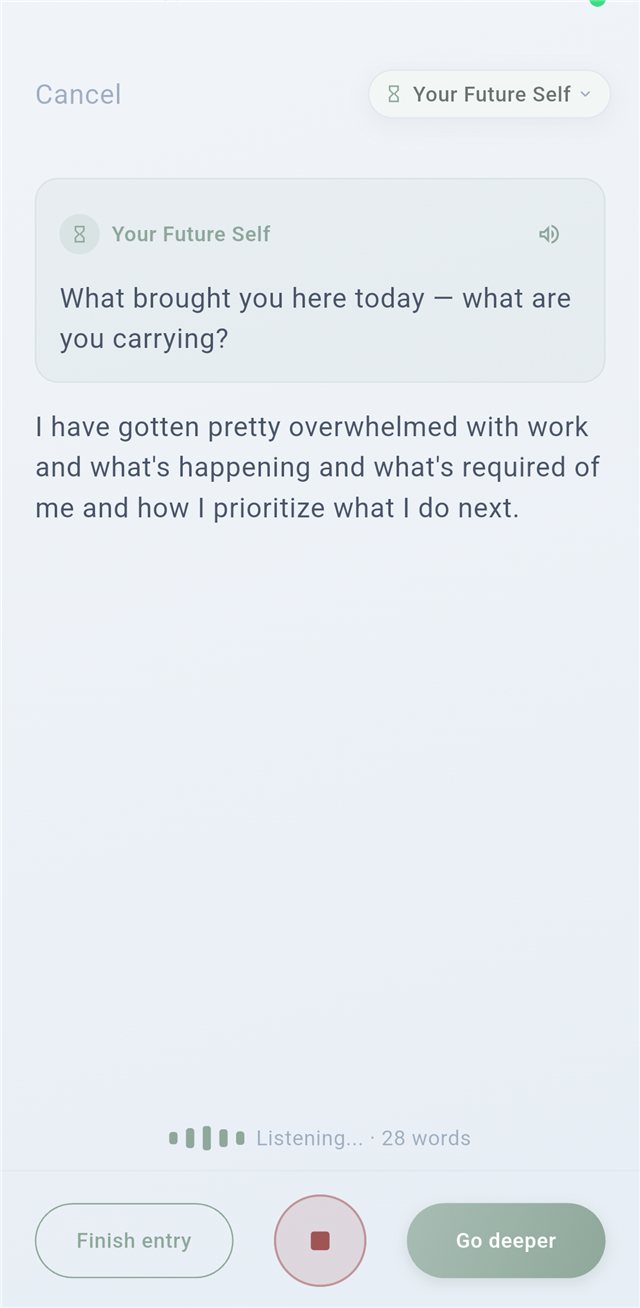
No blank page. No writing if you'd rather not. Just your voice, a guide, and the question you needed.
How to Start Today
No special equipment. Here's the shortest possible beginning:
- Set a timer for five minutes.
- Open any voice recording app, or just speak aloud.
- Say: "Right now I'm feeling…" and finish the sentence without stopping to edit.
- When you run out of words, ask: "What's underneath that feeling?"
- Answer that question too. Stop when the timer runs out.
That's a complete voice journaling session. If you'd rather have a guide handle the structure, asking the questions, holding the shape, surfacing what you couldn't have found alone, Nagi's founding-member beta is free on iPhone and Android.
Frequently Asked Questions
What is voice journaling?
Voice journaling is the practice of speaking your thoughts aloud instead of writing them, using your voice to process emotions, organise thinking, and arrive at clarity. A basic session is just you speaking for a few minutes, with intention. A guided session adds a companion who listens and asks follow-up questions, turning a raw speak-out into a structured reflection.
Is voice journaling better than writing?
For many people, yes, particularly if you find the blank page more obstacle than aid. Speaking is far quicker than handwriting, so thoughts tend to arrive before the editing brain can reshape them. Research by Bourdin and Fayol (1994) shows writing places a heavier cognitive load than speech, freeing bandwidth for reflection when you speak instead. Some people think best in written form, so it isn't universally better. But for verbal processors, overthinkers, and anyone who has abandoned written journaling, voice is often what finally fits.
What do you say when voice journaling?
Anything. The most effective sessions start with one sentence about what you're feeling right now: not what happened, not what you should do, just what's present. From there, speak without stopping to edit. If you run out of words, ask: "What's underneath that feeling?" That question does most of the work. A guide will ask it for you if you'd rather not hold the structure yourself.
Does voice journaling actually work?
Yes. Pennebaker and Seagal found that putting an emotional experience into language and shaping it into a coherent narrative produces measurable improvements in mood, immune function, and cognitive clarity. The key is structure. Speaking without a prompt or guide can extend the spiral rather than resolve it, while a specific question changes the session from venting to reflection.
What is the best voice journaling app?
The most effective voice journaling apps pair you with a guide rather than just a recorder. Nagi gives you ten guides, grounding, analytical, gentle, stoic, challenging, and more, trained on frameworks including CBT, Stoic philosophy, and IFS. You speak; the guide asks what you need to hear next. Free during the founding-member beta on iPhone and Android.