You open the notes app. You have something to say, and it's been rattling around for two days. The cursor blinks. The thought that was right there thirty seconds ago has split into four other thoughts, and now you're wondering whether you replied to that email, and why that one conversation still feels unfinished, and whether you remembered to eat lunch.
ADHD journal prompts exist because the blank page doesn't fail everyone equally. For non-linear minds, it fails almost every time. Not from lack of things to say. From too many: arriving all at once, at speed, without obvious order.
A specific prompt changes that. It gives you one narrow opening to answer. Below are fifteen of them.
Why ADHD journal prompts work when free writing doesn't
ADHD thinking is fast, associative, and non-linear. Two thoughts spark a third, which reminds you of a conversation from last week, which pulls you somewhere completely different. Writing is a linear medium. You slow to somewhere around 15 words a minute by hand and put one word in front of the next, in order. By the time your hand catches up, the original thought has changed shape.
Open-ended journaling asks you to organise your thoughts before you've had a chance to say them. For most people that's fine. For an ADHD brain, it's the hardest possible starting point.
A specific prompt reverses the dynamic. Instead of "write what you feel," it says: here is one small opening. Answer only this. The narrow frame does the work; it's the tool, not a restriction.
There's a body of research behind why externalising helps at all. James Pennebaker, a pioneer of expressive-writing research at the University of Texas, spent decades finding consistent results: putting inner experience into words reduces the cognitive load of holding it in. The brain stops working so hard to suppress what it can now see. For an ADHD brain already running several processes simultaneously, that reduction is real, not theoretical.
15 ADHD journal prompts, organised by what your brain is doing right now
Pick one. Not five. Read it, then answer it: in a sentence, a fragment, two words. There is no minimum. The goal is to get the thought out before the spiral starts, not to write something worth reading.
When your head is too full to start
- What's the loudest thing in my head right now? Just name it.
- What have I been meaning to say to someone and haven't yet?
- What did I start today that I didn't finish, and why didn't I finish it?
- What's been sitting in the back of my mind for three days that I haven't looked at?
- What am I avoiding right now, and what happens if I stop avoiding it?
When the feelings are blurry
- What am I actually feeling underneath the restlessness?
- Is this anxiety, boredom, or something I haven't named yet?
- What happened today that I'm still carrying around?
- If my brain were a weather event right now, what would it be?
- What am I pretending is fine that isn't quite fine?
When you want to understand a pattern
- When did I feel most like myself in the last week?
- What did I do today that I'd tell a friend was actually hard?
- What do I need right now that I haven't asked for?
- What pattern did I notice about myself recently that I haven't said out loud?
To end on something solid
- If I could tell tomorrow-me one thing, what would it be?
Notice what they share. They're short. They're specific. They have a stopping point built in: a place where the answer naturally closes rather than opening into more questions. ADHD brains do better with a fence around the field.
How to use ADHD journal prompts without turning it into a task
Five minutes is enough. Shorter is fine. The ADHD brain doesn't need a twenty-minute session to surface something real; it needs permission to say the one true thing quickly and then stop.
Set a timer if you need to. Five minutes means the session has an end, which matters more than it sounds. Open-ended time is where ADHD attention goes to wander.
If writing is itself the friction, try speaking instead. Most people speak several times faster than they can write by hand. For a mind that moves at that speed, voice matches the pace of the thought. You say what's there before the internal editor steps in to revise it. The thought lands before it scatters.
You can speak into a voice memo, into the air, or into a guided journal that asks the follow-up question. What you can't do is go wrong. There's no format to fail at. The only rule is one prompt, one answer, and out.
For a deeper look at why the blank page fails ADHD brains structurally, not just when you're tired but by design, the piece on ADHD journaling and the blank page problem covers the full picture.
When you want something that asks the next question for you
The hardest part of journaling with ADHD is rarely answering the question. The hard part is knowing which question to ask yourself next, when you're already mid-spiral and your brain has six other things it's trying to hold.
That's what Nagi does. You pick a guide from ten options, a grounding Zen presence, a direct Stoic, a quiet companion who simply listens, and you speak whatever's on your mind. The guide listens, then asks the follow-up: something specific to what you just said, rather than a generic prompt off a list.
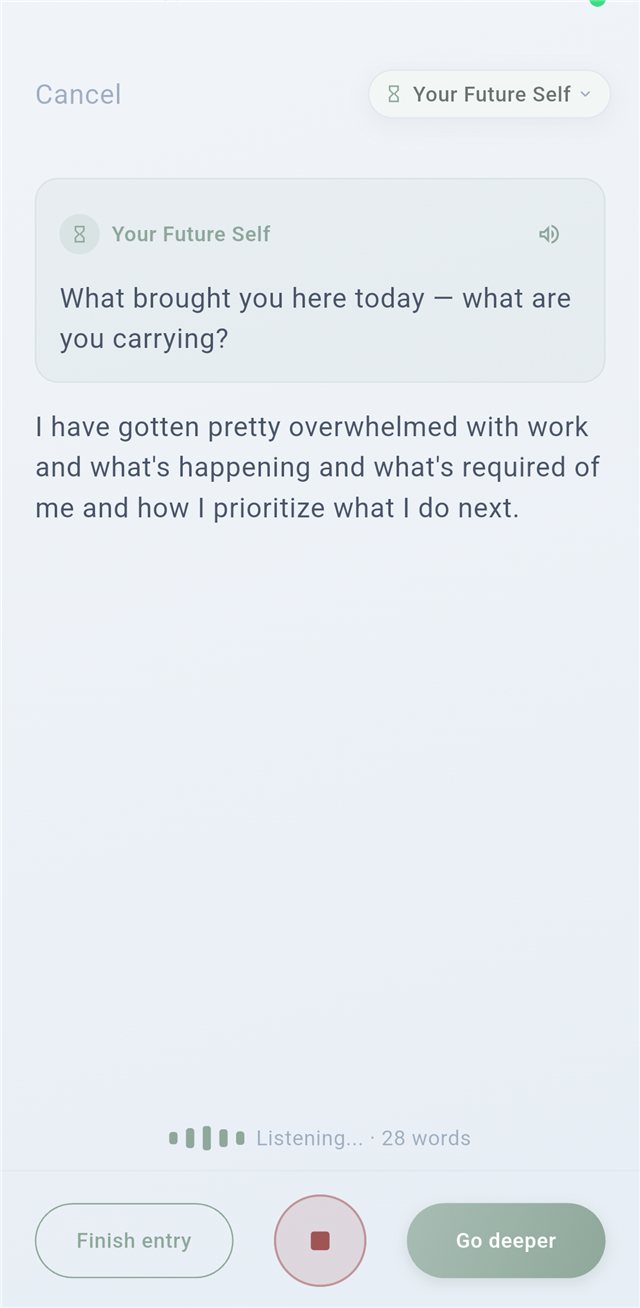
No blank page. No deciding what to write next. No pressure to form a sentence before the thought is ready. Just your voice and a question that arrives at exactly the right moment.
If you've tried journaling before and found the blank page was the obstacle, this is the version built for how you actually think. (→ Journal for Overthinkers)
Frequently Asked Questions
Do ADHD journal prompts actually work?
Yes, when they're specific enough. The trouble with generic journaling advice for ADHD brains is rarely the journaling itself. A blank page or a vague prompt like "write what you feel" gives a non-linear mind nothing to grip. A well-designed ADHD journal prompt is narrow enough to answer in one sentence. That narrowness is the point: it keeps the thought from scattering before it lands. Pair this with speaking instead of writing, and most ADHD brains find the friction drops dramatically.
How do I journal when I can't focus?
Skip the blank page. Pick one prompt from this list, just one, and set a timer for five minutes. Your answer doesn't need to be a paragraph. A sentence is enough. Two words is enough. If writing is the friction point, speak your answer out loud instead. Most people speak several times faster than they can write by hand. For a mind that moves at that pace, voice matches the speed of the thought. You say what's there before the internal editor steps in to revise it.
Is journaling good for ADHD?
The research says yes, when the format fits. James Pennebaker, a pioneer of expressive-writing research at the University of Texas, spent decades documenting consistent benefits from putting emotional experience into words: lower stress, clearer thinking, better self-understanding. For ADHD specifically, the format matters as much as the practice. Open-ended free-writing on a blank page can scatter a non-linear mind further. Structured prompts and voice journaling remove that obstacle and let the actual benefit through.