You downloaded Day One because the idea was lovely: a private place to keep your life, photos and weather and all. You looked for a Day One alternative only later, once the truth set in. The app was fine. You weren't using it. There's a blank entry sitting open, a cursor blinking, and the small daily ask to type out how you feel that you keep meaning to answer and never quite do. If that's the moment you're in, this is for you, and the alternative you actually want might not look like another writing app at all.
Before anything else: Day One is good. Properly good. So this isn't a takedown. It's about who the format fits, and what to reach for when it doesn't fit you.
What Day One Does Genuinely Well
Day One has earned its reputation. It launched in 2011, won an Apple Design Award in 2014, and was acquired by Automattic, the company behind WordPress.com, in 2021 (Wikipedia; TechCrunch). More than a decade in, it's polished in the way only long-lived software gets to be.
A few things it does that are hard to match:
- A genuinely rich archive. Photos, video, audio, and even Apple Pencil drawings live inside entries, with location, weather, and date logged automatically (Day One features). It's a scrapbook as much as a diary.
- End-to-end encryption, on by default and free. Day One encrypts entries across its apps and lists this on the free tier, with no paywall (Day One encryption).
- Everywhere you are. iPhone, iPad, Android, Mac, Apple Watch, and the web, so you can start an entry on one device and finish on another (Day One features).
- Memories that resurface. "On This Day" pulls up what you wrote a year or five years ago, photos included. For people who keep at it, that compounding archive is the whole reward.
- Structure when you want it. Templates and daily writing prompts give a starting shape, and reminders and streaks nudge the habit along.
If you write happily and you want a beautiful, secure record of your life, Day One is one of the best things you can install. None of that is in question here.
Why a Day One Alternative Crosses Your Mind Anyway
Here's the part the feature list doesn't cover. Every one of those strengths assumes you'll type. The archive only fills if you write into it. The streak only holds if you sit down and put words on the page. And for a lot of people, that's exactly where it quietly falls apart.
The blank entry isn't a neutral surface. It asks you to be articulate before anything is out: have a thought, shape it into a sentence, get the sentence right, all before you've actually worked out what you feel. For some minds that's no trouble. For others it's the whole obstacle.
Three kinds of people tend to bounce off it:
- Verbal processors. You've always thought out loud, on walks, in the shower, in long voice notes to a friend. Asked to type it instead, the thinking stalls. The keyboard isn't where your ideas live.
- Overthinkers. Typing is slow enough that the gap between thinking and recording becomes the place the spiral re-enters. You write a line, reread it, judge it, delete it. The tool meant to settle you hands you one more thing to manage.
- People with ADHD. The friction of opening the app, facing the blank field, and composing a tidy entry is often just enough to make "later" win. The intention was real. The format ate it.
If you're nodding, notice what's actually happening: you're not leaving Day One. You're leaving writing. The app was never the problem. The keyboard was.
How Nagi Is Different (Not Better, Different)
Nagi isn't trying to out-feature Day One. It's built on a different starting assumption: that for a lot of people, the natural way to process isn't typing, it's talking.
So there's no blank page. You open Nagi, press record, and just speak, raw, unedited, whatever's actually present. You don't need your thoughts in order first. Speaking is how you find out what they are.
The part that makes it more than a voice memo is the guide. As you talk, a guide listens and asks the next question, the one you wouldn't have asked yourself, the one that moves a thought from where it's been circling toward somewhere it hasn't been. When you're done, you get a composed reflection back: not a raw transcript, but something shaped, clearer than the storm that went in. Your spoken words stay private to you.
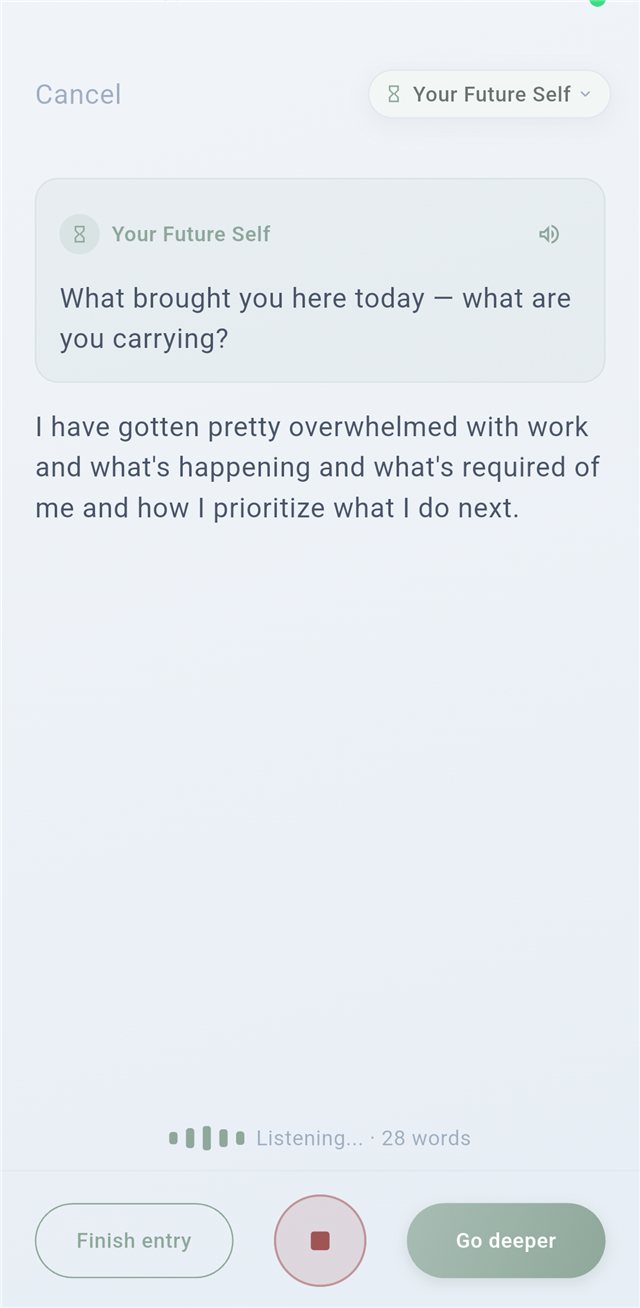
It's the difference between a place to store reflection and a thing that helps you do it. If you've never managed to keep a written journal, that distinction is the whole ballgame. New to the idea? Start with what voice journaling is, or see how the two formats compare head to head in voice journaling vs writing.
Day One vs Nagi: An Honest Comparison
Different tools, built for different people. Here's the straight version, strengths on both sides.
| Day One | Nagi | |
|---|---|---|
| Input | Type, with photos, video, audio, and drawings | Speak: you talk, no typing required |
| Guidance | Templates, daily prompts, streaks | A guide listens and asks the next question live |
| What you get back | The entry you wrote, archived | A composed reflection shaped from what you said |
| Privacy | End-to-end encryption, free tier, on by default | Spoken entries kept private to you |
| Platforms | iPhone, iPad, Android, Mac, Apple Watch, web | iPhone and Android |
| Media & photos | Rich: a full multimedia archive | Voice-first; not built as a photo album |
| Best for | People who write happily and want a lasting record | People who quit text journaling and process out loud |
Read that table honestly and the split is clear. Day One wins on archive, media, platform reach, and encryption maturity. Nagi wins on getting a reluctant journaler to actually open the app and say something true.
Who Should Stay on Day One, and Who Should Try Nagi
Not everyone reading this should switch. Switching for its own sake is how you end up with two apps you don't use.
Stay on Day One if: you write happily, you want a media-rich archive with maps and photos, you treasure the "On This Day" memories, you need it across Mac, web, and Apple Watch, or end-to-end encryption on a mature, long-running app is your deciding factor. Day One is excellent at being Day One. Keep it.
Try Nagi if: you keep meaning to journal and never do, the blank page stops you cold, you already process by talking to friends or into voice notes, you're an overthinker who needs the next question rather than more empty space, or you've started and abandoned a written journal more than once. You're not the problem. The format was.
There's no rule against running both, either. Some people keep Day One as the archive and use Nagi as the place they actually think out loud on a hard day.
The Cheapest Way to Find Out
You can read comparisons all afternoon. The only test that settles it is speaking one entry and noticing how it feels, whether the words come more easily than they ever did on a keyboard.
Nagi is free to try on iPhone and Android. Open it, press record, and say the first true thing that comes to mind. If talking turns out to be how you've been processing all along, you'll know inside a minute, and the blank page won't be the thing standing between you and reflection any more.
Frequently Asked Questions
What is the best Day One alternative?
It depends on why Day One stopped fitting. If you loved the polished app, the photos, and the memories but kept abandoning entries because typing felt like work, the best alternative is a voice-first journal. Nagi lets you speak instead of type, with a guide that asks the next question and hands back a composed reflection. If you want a richer media archive and you write happily, Day One is hard to beat and you may not need an alternative at all.
Is there a journaling app where you talk instead of type?
Yes. Nagi is built around speaking rather than writing. You open it, talk for a few minutes about whatever's present, and a guide listens and asks follow-up questions. At the end you get a composed reflection back instead of a raw transcript. There is no blank page and no keyboard to fight, which is the main reason people who quit text journaling stick with it.
Why do people leave Day One?
Day One is a genuinely good app, so most people who leave aren't unhappy with the product. They leave because the format never fit how they think. The blank entry asks you to be articulate before anything is out, and for verbal processors, overthinkers, and people with ADHD, typing is friction that ends the habit. Leaving Day One is usually about leaving writing, not leaving Day One.
Does Nagi have end-to-end encryption like Day One?
Day One offers end-to-end encryption across its apps, included on the free tier. Nagi takes a different privacy posture: your spoken entries are private to you, and the app is built so your raw words stay yours. The two apps weigh privacy differently because they're built for different things, so check each app's current privacy details before you decide.
Should I switch from Day One to Nagi?
Not everyone should. If you write happily and want a media-rich archive with maps, photos, and On This Day memories, stay on Day One. Switch, or run both, if you keep meaning to journal but never do, if the blank page stops you, or if you already process by talking to friends or into voice notes. Nagi is free to try, so the cheapest way to know is to speak one entry and see how it feels.