You already know how to send a voice note. The words come fast, unfiltered, the feeling still attached. Then you open a journal and try to write the same thing down. Something shifts. The thought slows, reorganises itself, loses its edge before it reaches the page. The feelings that were clear in your mouth look different when your hand has to keep up. If you've ever wondered whether a voice journal app actually does something different from a notebook, the answer matters, and it's not what most journaling advice will tell you.
Why speaking and writing feel so different to use
The gap is mechanical before it's anything else.
Most people speak at well over a hundred words a minute. Handwriting runs at a fraction of that, and typing, though faster, still trails speaking speed by a wide margin. By the time your hand catches up, the thought has changed shape inside your head. For a non-linear mind, one that branches, doubles back, and connects things that don't obviously connect, writing introduces a bottleneck at the worst possible moment: right as the thought is forming.
There's a second problem. Writing is self-editing by nature. You slow down to choose the word, to check the sentence, to make it look roughly like what you meant. Speaking isn't. Speech is continuous. The first word calls the second one forward without stopping to ask whether it's correct. That continuity is where the unfiltered thought lives: the one that hadn't been shaped into something acceptable yet.
This matters more for some people than others. If you process by talking things through out loud, on walks, in the car, in the shower, you already know what happens when you try to write instead. The thing you were going to say doesn't always survive the transfer.
What the research actually says
The most cited body of work on this is James Pennebaker's. Since his seminal study in 1986, the expressive-writing paradigm he started has been tested across well over a hundred studies (a single 2023 review counts 146 in one meta-analysis alone) on what happens when people externalise their emotional experiences. The consistent finding: putting feelings into language reduces the physiological and psychological burden of holding them in. The brain stops working so hard to contain what it can now see.
Two things made the difference across his studies. First, depth of engagement: the more fully the person entered the experience, the larger the benefit. Second, the development of narrative coherence: the movement from scattered fragments toward something that tells a story. Messy in, structured out.
A 2023 study published in the journal Behaviour Change (Cambridge University Press) confirmed the pattern for journaling interventions that engage self-reflective processes. The mechanism is the same: a thought observed is easier to work with than a thought still running the show from inside your head.
What voice adds is emotional fidelity. Research by Kraus (2017) found that voice-only communication can read another person's emotional state more accurately than channels that also carry visual cues. Written words capture content. Voice captures tone, pace, and the catch in the throat that the word itself doesn't convey. A voice journal does more than speed up writing: it produces a different kind of record altogether.
When a voice journal app wins (and when writing is better)
Speaking wins in the raw moments.
When the emotion is still attached to the thought. Before the editing brain steps in and makes it presentable. When something just happened and you need to process it before you can even figure out what you think. Voice works there. Writing is useful for the second pass: when you know what you want to say and you need to work out how to say it with some precision.
If you're the kind of person who thinks by talking things through, the walks, the replaying conversations out loud, the voice notes you send before you know what point you're making, writing imposes structure before the thought is ready for structure. You can't draft what you don't yet know. Voice doesn't ask you to.
Writing isn't wrong. It works well for deliberate thought: planning a conversation you're nervous about, thinking through a decision with a lot of variables, reviewing a week from a position of relative calm. The editing that feels like friction when you're upset is really useful when you're strategising. Writing makes you argue with yourself more precisely.
The blank page is only a problem when you bring the unsorted thing to it.
If you're new to voice journaling and want to understand what the practice actually involves, start here: What Is Voice Journaling? What distinguishes a good voice journal app from a simple voice memo recorder is the next question, and that's where it gets more interesting.
What a voice journal app actually does differently
A voice memo and a voice journal app are not the same thing.
You probably have a voice memo app on your phone right now. When you play back those recordings, the thought that needed to be had usually isn't in there. You vented. Nothing came back to you. The memo captured sound. It didn't ask the follow-up question.
A voice journal app does something different. It listens, then asks the next question: the one your own mind probably wouldn't have thought to ask. The structure that comes back at you is what turns an outpouring into a reflection. The speaking on its own won't do it.
This is what Nagi is built on. There are ten guides to choose from: a grounding Zen voice, a direct Stoic, a quiet companion who just listens, and seven others. You speak whatever's on your mind. The guide doesn't offer answers. It asks the question underneath the one you came in with. The storm you arrived with has a shape by the time you finish. You can actually see it.
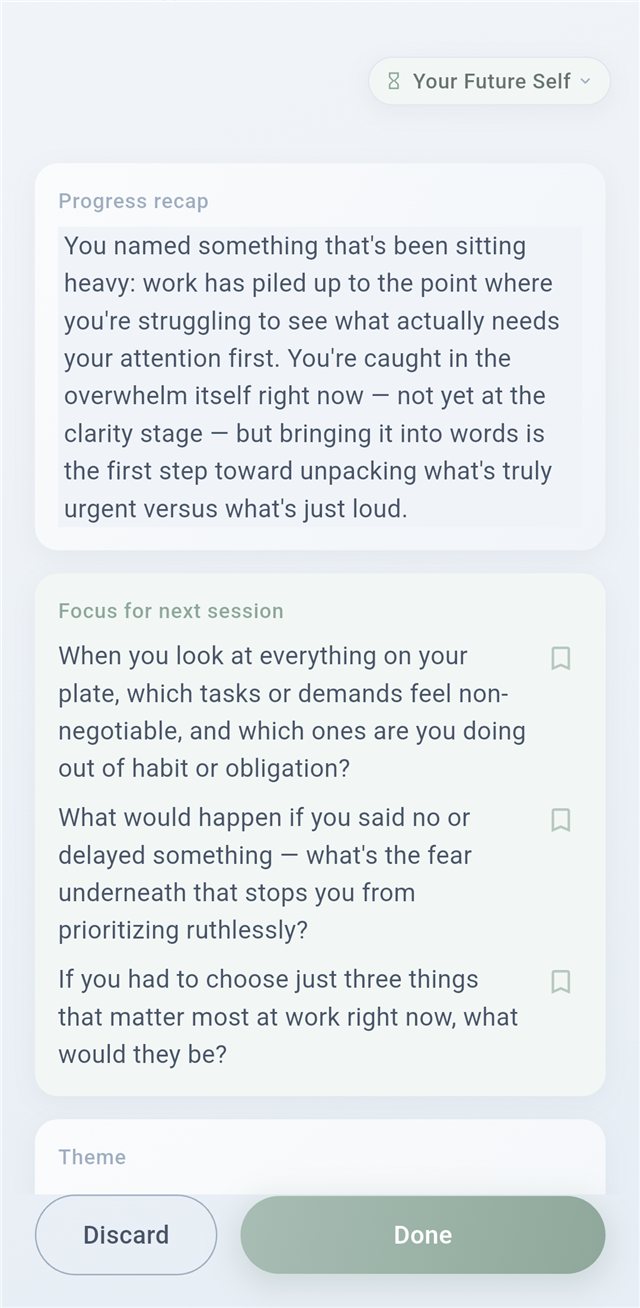
For the specific spiral that comes from overthinking rather than emotional overflow, the same principle applies, with different entry points: Journal for Overthinkers: Stop the Loop, Start Reflecting.
How to tell if a voice journal app is right for you
There's a simple test.
Think about the last time something bothered you. What was your first instinct? Did you want to call someone and talk it through? Did you find yourself composing a message before you knew what you actually wanted to say? Did you replay the situation out loud on a walk, or in the shower, or driving home?
If yes to any of those: voice is your format. A good voice journal app intercepts a habit you already have and gives you something structured back.
If your first instinct was to open a notes app and start bullet points, writing works well for you. Both have a place. Most people with busy, fast-moving minds use voice for the first pass and writing for the second. The question isn't which one is "better." It's which one catches the thought before it changes shape.
Frequently Asked Questions
Is voice journaling actually effective?
Yes, but with one important condition. The mechanism is the same whether you speak or write: externalising a thought creates psychological distance, which reduces the physiological and psychological cost of holding it in. Pennebaker's research across well over a hundred studies shows consistent benefits for people who engage with the practice at depth. What voice adds is that it removes the friction that stops many people from getting to depth at all. For verbal processors, the blank page problem simply doesn't come up.
What's the difference between a voice journal app and just talking to yourself?
Talking to yourself externalises the thought, which is useful. But without a question that comes back to you, the thought tends to circle. You rehearse the problem rather than understand it. A voice journal app closes the loop. It listens, then asks the next question: the one you've been avoiding, or the one your own mind wouldn't have thought to ask. Voice memos also miss this. They capture what you said; they give nothing back.
Can a voice journal app replace traditional journaling?
For most people, it works less like a replacement and more like a better fit for a different kind of moment. Writing works well for deliberate, structured reflection: reviewing your week, planning ahead, capturing something you already understand. Voice journaling works better in the raw moments: when something just happened, when the thought hasn't been sorted yet, when the editing brain would sanitise it before it reached the page. The two complement each other. Many people end up using voice for the first pass and writing for the second.
Is a voice journal app good for anxiety?
Speaking rather than writing tends to reduce the friction that stops anxious people from processing at all: the blank page, the pressure to write coherently, the editing loop. Voice moves at the speed of thought, which means the anxious thought leaves you before your internal editor has a chance to rephrase it. The follow-up question also matters: anxious minds tend to spiral when left to direct their own reflection. A prompt that redirects, asking "what do you actually need right now?" rather than "why do you feel like this?", breaks the loop rather than extending it.
How long does a voice journal session need to be?
Shorter than you'd think. Pennebaker's clinical work used 15 to 20 minute sessions, but that was for processing significant trauma. For everyday emotional maintenance, the spiral before bed or the tension after a hard conversation, two to five minutes is usually enough. Speaking for three minutes gives you more material than most people generate in fifteen minutes of writing. The goal isn't a complete inventory of everything you're feeling. It's to ask one good question and see where it leads.