You've been journaling for two weeks. You sit down each night, you get the words moving, you fill the pages. And nothing has shifted. The same thoughts are circling. The same tight feeling in your chest. You're doing the thing, and the thing isn't doing anything back.
So you search: does journaling work? You find thousands of articles saying yes, with studies and testimonials, but nobody seems to answer the question underneath it: how long before you can actually tell?
This is what the research actually says.
Does journaling work? What decades of research show
Yes. But not in the way most journaling advice describes.
James Pennebaker, professor of psychology at the University of Texas at Austin, spent four decades studying what happens when people write about emotionally significant experiences. His research points to a consistent finding: putting feelings into words, in a purposeful way, reliably reduces the psychological effort of holding those feelings in. That effort is real. When we carry unprocessed emotion, it takes up working memory and taxes the body. Externalising it, through writing or speaking, takes it out of active circulation.
But the mechanism that matters is not the act of writing. It's what the writing produces. The people who benefit most are those whose writing moves toward meaning: a narrative that develops, that shifts from fragment toward something more whole. Describing the same feeling in circles generates far less benefit than writing that moves somewhere.
That distinction matters. It explains why journaling can feel like it isn't working even when you're doing it consistently.
How long does it take for journaling to work?
The honest answer: it depends on what "working" looks like to you.
In Pennebaker's original protocol, participants wrote for fifteen to twenty minutes on three or four consecutive days. Physical health improvements, measured by physician visits and immune markers, appeared in the weeks and months that followed. But something else arrived earlier: a shift in the relationship to the thought, rather than the thought itself.
For most people, the first change is psychological distance. The worry that felt like it was happening inside you starts to feel like something you're observing from outside. It has edges. It has a shape. That can arrive within the first few sessions. And it's the foundation for everything that follows.
Pattern recognition comes later. After weeks of consistent practice, you start to see which situations reliably trigger which feelings. You write about the same fear in different language and recognise it as the same fear. That recognition compounds quietly, week by week, rather than arriving as a single insight.
The timeline is not dramatic. Most people don't notice a shift and think "it's working." They just find themselves slightly less inside the thought than they were before.
What changes first, and what to watch for
The signs of journaling working are not what people expect.
The first signal: the thought that has been running at the edge of every other thought suddenly has a place to be. It's in the notebook. It's been said. You don't have to keep carrying it. Not because you solved it. Because you put it down.
Another signal: you leave a session knowing something you didn't know when you sat down. Not a solution. A clearer description of the problem. The shape of the thing is visible now, and that shape is quieter than the shapeless version was.
A third: you start to catch yourself earlier in the spiral. Before the loop is at full speed, something in you says, wait, I recognise this. That's the pattern recognition arriving. It's slow. But it builds.
If none of these are happening after several weeks of consistent practice, the format is probably the issue. Not the practice.
When journaling doesn't work, and why
Not every form of journaling produces the benefits the research documents.
The psychologist Susan Nolen-Hoeksema spent years distinguishing carefully between reflection and rumination. Her research found that dwelling on distress without moving toward meaning tends to prolong that distress rather than resolve it. (Nolen-Hoeksema, 1991) A blank page with the instruction "write what you feel" invites rumination far more often than it invites reflection. You write about how bad things are. The writing keeps them vivid. You don't get the psychological distance. You get more of the same thought.
The fix is structure. A specific prompt with a direction. A question that opens onto something new rather than circling what you already know. Fifteen minutes of purposeful writing outperforms an hour of journaling that goes nowhere.
For people who find writing itself gets in the way, there's a separate problem. The page requires a kind of slowing and organising that filters out exactly what they need to say. A thought that comes out raw when you speak it becomes measured and incomplete on paper. For those people, the format is the obstacle, not the practice. (See: Journal for Overthinkers)
What voice journaling does differently
Speaking your journal entry reaches material the page sometimes can't.
When you write, you edit as you go. The thought forms, passes through "is this worth writing down?" and "how do I say this?", and arrives on the page already modified. For verbal processors, the people whose first instinct when something goes wrong is to call someone and talk it through, that editing filters out the rawness that makes journaling useful. The thought you needed to say gets refined before it leaves you.
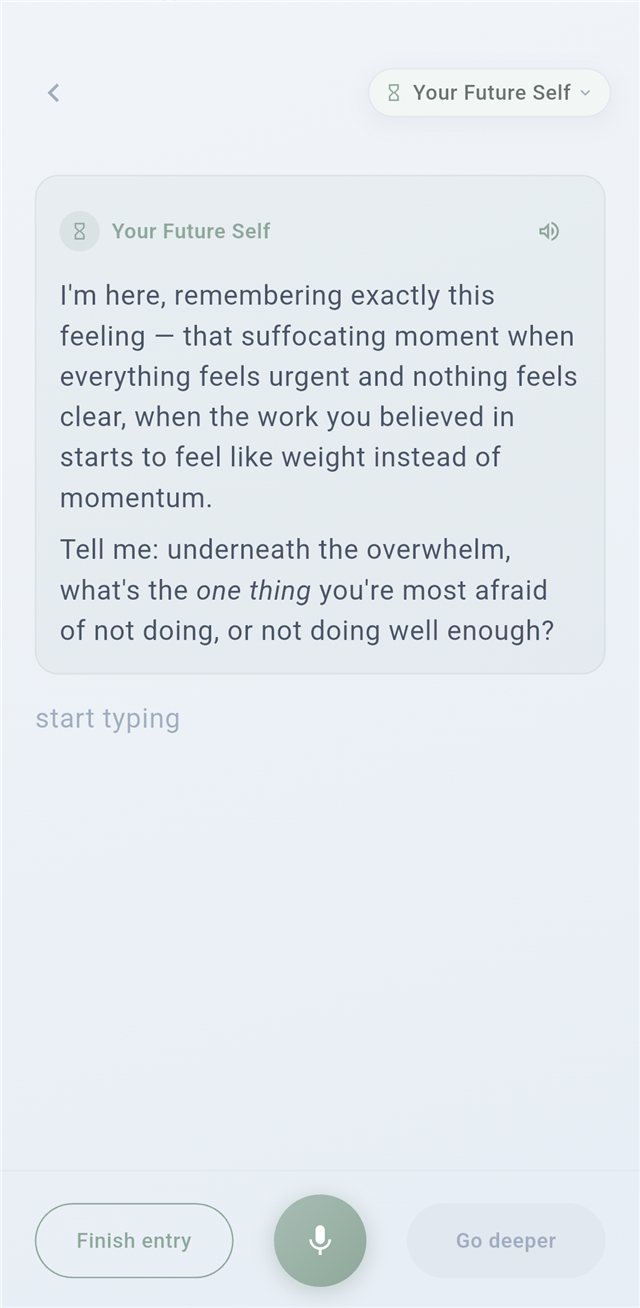
Nagi is built for this. You pick a guide: a calm voice, a direct one, a Stoic, a CBT framework, whichever fits the moment. You speak. The guide listens, then asks the follow-up question your own mind wouldn't have reached. What comes back is a composed reflection of what you actually said.
The result is the same thing Pennebaker's research documents: a thought outside yourself, with edges, with a shape. Just arrived at through the door that was already open for you. (See: How to Journal for Anxiety)
Frequently asked questions
Does journaling work if you do it every day?
Frequency matters, but regularity without intention has limits. Pennebaker's protocol worked in concentrated bursts: three to four sessions, then stopping. Daily journaling works when the quality stays high: specific prompts, movement toward meaning. If daily journaling starts to feel like a habit that generates words without generating clarity, try a specific prompt rather than a blank page. The practice is the structure, not the schedule.
How long until journaling shows results?
The first shift, a sense that the thought has an exterior, can arrive within the first few sessions. Pattern recognition builds over weeks. Deeper change compounds over months. Most people notice something within a few weeks of consistent, structured practice. The question is what you're looking for: if the bar is a single cathartic moment, you may be waiting for the wrong signal. Journaling works quietly, not dramatically.
What if journaling doesn't feel like it's working?
Try changing the format before abandoning the practice. Specific prompts outperform open pages. Five-minute sessions with a clear direction often outperform twenty-minute ones without one. For people who process better by speaking than by writing, voice journaling can reach what the page cannot. The research on expressive writing applies to spoken disclosure too: the medium is not the mechanism.