The notebook still has her name on the first page and nothing else. You bought it three days after the funeral because someone told you writing would help. For a few minutes, holding the pen, it felt true. Then nothing came.
Grief journaling gets recommended constantly, and the advice always assumes the same thing: that grief behaves like a thought you can sit down and finish. It doesn't. Grief arrives sideways, mid-sentence, while you're loading the dishwasher or stopped at a red light. By the time you're staring at a blank page, ready to "process," the moment that actually needed processing has already passed.
Why grief journaling on a blank page so often stalls
Grief research keeps bumping into the same frustrating wall. Writing your feelings down sounds like it should help, and sometimes it does. Not automatically. Not for everyone.
A 2006 meta-analysis in Psychological Bulletin pooled 146 randomized studies of expressive writing and found a positive, measurable effect on health and wellbeing (Frattaroli, 2006). Small. Real. Consistent across the kind of study and the kind of person doing it.
Then it hits widowhood specifically. The same meta-analysis notes a study where grieving community members were assigned to write expressively about their loss, nothing more structured than that, and showed no improvement over people who didn't write at all. Nobody's imagination failed them. The blank page did.
Why grief breaks the pattern that works for other feelings is still debated. One explanation fits what grief actually feels like from the inside. Anger, guilt, memory, longing, relief, sometimes all four inside the same minute, don't line up into a paragraph on command. Unstructured writing assumes you can find the thread. Grief, especially early, doesn't hand you one.
How to start grief journaling when the words won't come
What seems to move the needle isn't writing more. It's writing with a shape: a specific question that expects a specific answer, instead of an empty rectangle and a vague instruction to "get it out." One direct question, what do I miss most about an ordinary Tuesday with them, does something a blank page can't. It gives grief somewhere to land.
Speaking does this even more naturally than writing does. You don't need the sentence finished before you start it. You can circle back, repeat yourself, stop halfway through and start again. That's closer to how grief actually moves than a tidy paragraph will ever be.
This is where speaking it out loud earns its place, not as a replacement for grief, which has none, but as somewhere for it to go instead of being stared at on a page. The same mechanism shows up in journaling for emotional regulation: speaking bypasses the self-editing that writing invites, and for something as unedited as grief, that matters more, not less.
Some days the page just sits there. Say it instead, and let a guide ask the next question.
Free during the beta, on Android and iPhone.
Get early accessBuilt for the moment grief doesn't warn you about
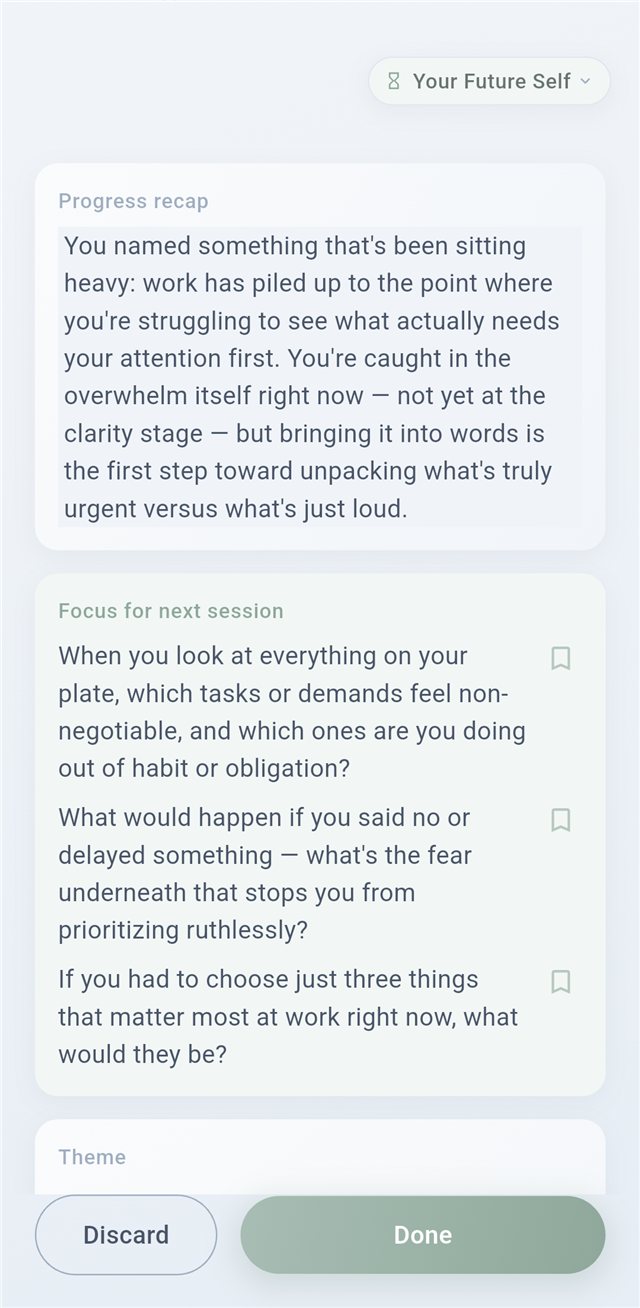
This is what Nagi is built for. You pick a guide, the quiet one who mostly listens works well here, and you talk about whatever's actually true today: the anger that showed up uninvited, the relief you feel guilty for, the ordinary Tuesday you'd give anything to have back. The guide doesn't rush you toward closure. It asks the next honest question, and what comes back is a reflection in your own words, something you can return to on the days grief comes back sharper than you expected.
Grief doesn't check your calendar before it arrives. Nagi doesn't either. It's there at midnight, on the drive home, in the three minutes before the next meeting starts. Grief doesn't observe business hours, and neither does a guide that's just an app on your phone, already there before you've had to explain why you're opening it.
Grief journaling prompts for when nothing comes out
These aren't the five-stages prompts you've seen before. They're built to meet grief where it actually shows up: specific, physical, and rarely in order. Pick one. Speak it or write it. Stop whenever it stops helping.
- What do I miss about an ordinary Tuesday with them, not a holiday, not the anniversary, just a Tuesday?
- What's something about how I'm actually doing that I haven't told anyone?
- Is there a conversation I wish I'd had, or wish I'd finished?
- What does this particular wave of grief feel like in my body right now?
- What would I want them to know about how I'm carrying this?
- What's something about them I'm afraid I'll forget?
- What do I need today that has nothing to do with "moving on"?
There's no right number of these to answer in one sitting. Some weeks none of them will come close. Other days, one question will crack something open that's been stuck for months, and that's the entry that matters, not the one you forced out because you felt like you should.
What grief journaling can't do, and what it can
Grief journaling won't shorten grief, and anyone who promises that is selling something. What it can do is give the hours between the hard days somewhere to go, instead of circling in your head at 2am or landing, again, on the one friend who's heard this story four times already. Journaling for depression covers the related, but distinct, territory of a mood that's heavy for weeks rather than a loss that's sharp and specific. Grief and depression share a neighbourhood. They aren't the same house. What grief journaling won't do is make the house quieter, or bring back the version of Tuesday that's gone. It just gives you somewhere honest to put the version you're in now.
Frequently Asked Questions
What should I write about when I'm grieving?
Not everything, and not in order. The instinct is to sit down and get the whole thing out, but grief rarely cooperates with a single session. A smaller, specific question works better: what do I miss about an ordinary day with them, not the big days, the small ones. If writing feels like a wall, speak the answer instead. That's exactly what guided voice journaling is built to catch: you talk, a guide asks the next honest question, and what comes back is something you can actually hold onto.
Does journaling actually help with grief?
The honest answer is: it depends how you do it. A widely cited 2006 meta-analysis of expressive writing research pooling 146 studies found that disclosure helps, modestly, across most contexts. But one study it reviewed found no benefit for widowed people who wrote about their loss in an unstructured way. The difference seems to be structure. A specific question gives grief somewhere to land. A blank page just asks you to find the shape yourself, which is exactly what grief makes hardest.
Is voice journaling better than writing for processing grief?
For a lot of people, yes, and the reason is mechanical rather than mystical. Writing asks you to finish a thought before it leaves you, which forces editing at the exact moment grief is least linear. Speaking doesn't have that requirement. You can start a sentence, abandon it, circle back, and land somewhere true without ever making it read well. Nagi is built around that difference: you speak, a guide asks the next question, and the reflection you get back is yours, not a tidied-up version of it.