Your hands are shaking and somebody, a therapist, a wellness account, your own sister, told you journaling would help. So you find the notebook. Sit down. Try to hold a racing chest still enough to write one sentence. By the time you've finished the first line, the feeling underneath it has already curdled into something else. You put the pen down. Journaling for emotional regulation was supposed to calm you down. Instead it asked you to slow down, at the exact moment your body wanted to move.
That's not a discipline problem. It's a mismatch between what regulation actually needs and what a blank page can give you.
Why Journaling for Emotional Regulation Backfires With a Blank Page
Emotional regulation is not the same job as emotional expression. Expression gets the feeling out. Regulation changes what happens to you while you're having it: how long the wave lasts, how large it gets, whether it drags you somewhere you didn't choose to go. A blank page is built for expression. You dump the feeling onto it, unfiltered, and hope something shifts.
Often nothing does. Writing is slow, and a feeling that's still building doesn't wait for your hand to catch up. You reach for the first word, then the second, and the anger or the panic has already moved three steps past whatever you just wrote. Instead of regulating the wave, you end up describing where it used to be.
There's a second problem underneath the first. Writing demands structure before the thought is finished forming: spelling, sentence order, a beginning and an end. For a body that's flooded, that demand reads as pressure. One more thing to get right while you're already struggling to get through the next sixty seconds. The page becomes a test. Regulation needs the opposite: a way to let the feeling move without also asking you to perform it correctly. We cover a related version of this mismatch in our piece on journaling for overthinkers, where the same blank page turns reflection into another loop.
What Emotional Regulation Actually Requires
Naming a feeling changes it. That's not a wellness slogan. It shows up across decades of research on expressive writing, and it only works if the naming happens while the feeling is still live, not an hour later once it's already flattened into a tidy paragraph.
Three things separate journaling that actually regulates from journaling that just describes. Speed: catching the feeling before it changes shape. Specificity: naming exactly what's happening in the body, not a vague mood word. And a stopping point: something that tells you the processing is done, so you're not still turning it over at 1am. Most standard journaling advice gives you none of the three. It hands you a page and says write what you feel, which is a fine instruction for reflection and a poor one for regulation.
The Science: How Speaking Regulates Emotion Differently Than Writing
James Pennebaker's expressive writing research is the foundation here. A 2006 meta-analysis in Psychological Bulletin pooled 146 randomised studies of people writing or talking about things that mattered to them, and found a small but significant benefit. Modest, not miraculous. The mechanism is externalising. Holding a feeling in costs the body something; putting it into words lowers that cost. This is the same research base behind our anxiety prompts piece.
A newer strand of research points at why the reflective part matters as much as the expressive part. A 2023 study in Behaviour Change (Cambridge University Press) followed people using an app-based journal for a month and found their psychological wellbeing improved only when their baseline tendency toward self-reflection was average or higher. For people who weren't naturally reflective, the journaling didn't move the needle. What mattered was whether the person was actually processing, not just producing text.
Speaking adds something writing can't add by design. Kraus (2017), writing in American Psychologist, ran five experiments with over 1,700 participants and found that people read emotion more accurately from a voice alone than from video alone or from voice and video together. Tone, pace and the catch in a sentence carry a lot of the feeling, and that is exactly what typing strips out. When you're trying to regulate rather than just record, that extra channel matters. You hear yourself catch on a word, and something registers that a typed sentence would have hidden from you.
Speaking also moves closer to the pace feelings actually change. You don't have to hold the wave still while your hand works out spelling and word order. The words leave near the moment they form, which means regulation can happen while the feeling is still there to regulate. Calm, considered reflection is a different, later task. It needs the feeling to have already passed. Regulation needs to meet it while it hasn't.
Voice Journaling for Emotional Regulation: How It Actually Works
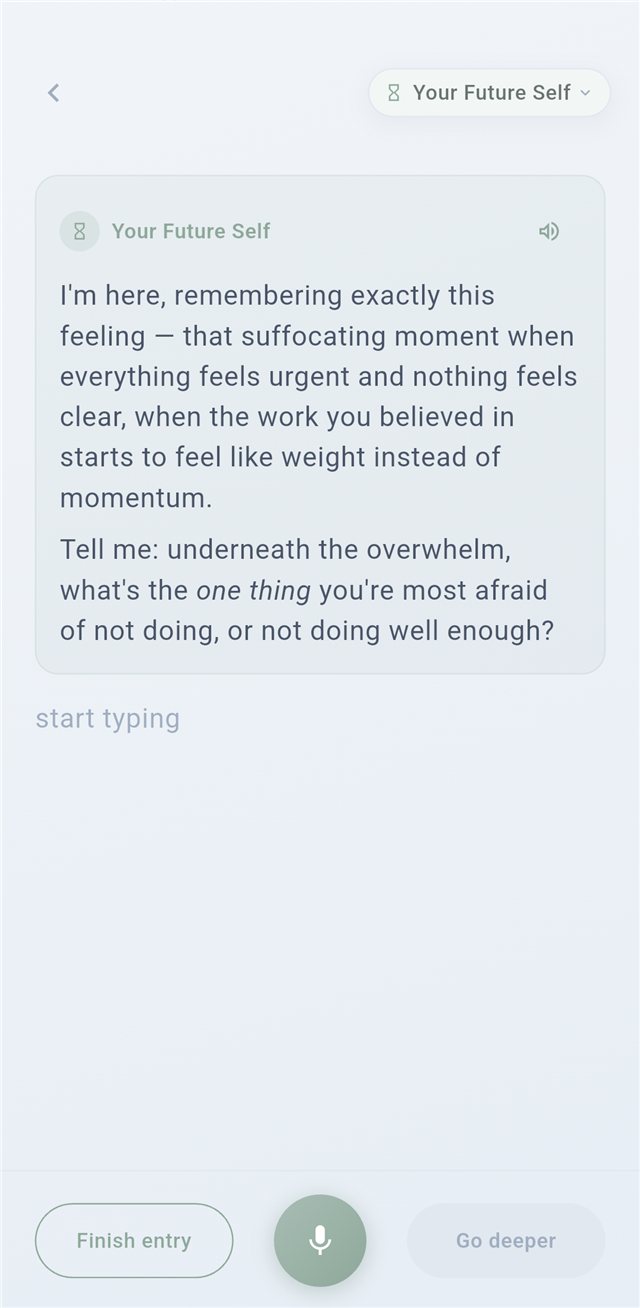
This is the gap voice journaling closes, and it's the reason Nagi is built the way it is. You open the app while the feeling is still live, not after you've had time to compose yourself into something presentable. You speak whatever is actually happening, out loud, without the pressure of finding the right sentence first.
The guide doesn't just receive the dump and go quiet, the way a voice memo would. It asks the next question, the one that moves you from expressing into regulating: where this is actually sitting in your body right now, and what it needs from you in the next five minutes rather than the next five years. That's the difference between venting into a recorder and being asked the one question that actually settles something.
You don't need the right words first. You don't need the feeling organised into a shape before you start. The guide does that part in real time, while the feeling is still moving, which is precisely the window a blank page misses. If the blank page itself is the sticking point, not just the timing, we go deeper on why that happens here.
Next time a feeling is still building, say it out loud while it's fresh, and get a written reflection back once it settles.
Free during the beta, on Android and iPhone.
Get early accessWhat to Try When You Need to Regulate, Not Just Vent
These are built for the moment the feeling is still moving. Say them out loud if you can. Reading them silently defeats the point.
- Name where it's sitting in your body, and how big it is right now. Not the story behind it. Just the physical fact of it.
- Say the sentence you're afraid of, once, out loud. The one you've been avoiding. Let it exist outside your head for a second.
- Ask what this feeling needs from you in the next five minutes. Not the next five years. Five minutes is a question you can actually answer.
- If you're still spinning after two minutes, name one thing you can control right now. Anything. Your breath counts.
- Notice when the wave has actually passed. There's usually a small, specific moment. A loosening in the chest. That's the stopping point most journaling advice never gives you.
None of these require good handwriting or a full paragraph. They work exactly as well spoken into a phone at 11pm as they do written in a leather notebook at a desk. Better, usually, because nothing is asking you to slow down first.
Frequently Asked Questions
What is journaling for emotional regulation?
Journaling for emotional regulation means using the act of putting a feeling into words, spoken or written, to change what happens to you while you're having the feeling: how long it lasts, how large it gets, whether it pulls you somewhere you didn't choose to go. That's a different job from journaling to vent or to record what happened. Regulation is about the feeling's shape while it's still moving, not a summary of it after the fact.
Why doesn't writing help regulate emotions in the moment?
Writing is slow relative to how fast an emotional wave can build and shift, and it demands structure, spelling, sentence order, a beginning and an end, before the feeling has finished forming. That's a lot to ask of a body that's already flooded. By the time a sentence is finished, the feeling underneath it has often already changed. Writing suits reflection well, once a feeling has passed. Regulating one while it's still happening is a harder task for the same tool.
Can voice journaling help with emotional regulation?
Yes. Speaking lets you put a feeling into words close to the pace it's actually changing, without the delay writing introduces. Research on voice communication also suggests tone and pace carry emotional information that gets stripped out once a feeling is typed. Voice journaling that asks a follow-up question, rather than simply recording what you say, adds a second piece: a prompt that moves you from expressing the feeling toward actually regulating it, such as asking what the feeling needs from you in the next five minutes rather than why it's there.
What's the difference between journaling to vent and journaling to regulate?
Venting empties a feeling onto the page or into a recording and leaves it there, unchanged in shape. Regulating asks something of the feeling: where it's sitting, how big it actually is, what it needs from you right now. A vent is a full stop. Regulation is a question that moves you somewhere. Both have a place, but only one of them is built to shorten an emotional wave while it's happening.