Twelve tabs are open in your head right now. You can't tell which one is making the noise. There's a sink full of dishes, three texts you haven't answered, a deadline that was supposed to be yesterday's problem, and somewhere underneath all of it, a feeling you haven't had time to name. You don't need a new system for this. You need journal prompts for overwhelm that don't ask you to sit still and write it all down in order, because sitting still is the one thing you cannot do right now.
This is a different animal from overthinking. Overthinking loops. Overwhelm floods.
Why journal prompts for overwhelm work differently than venting
Overwhelm isn't one thought circling with no new information arriving. It's too many real things, each one legitimate, landing at the same time with no shared queue. Your brain doesn't have a tray for twelve urgent items. It has room for about one. So the system stalls. Not because you're incapable. Because you're trying to rank a pile while new things keep landing on top of it.
Standard journaling advice says to write it all out. That's the wrong fix for this particular moment. Writing asks you to pick one thread and follow it in order, word by word, start to finish. Overwhelm is the opposite of orderly. Asking an overwhelmed brain to write in sequence is asking it to do the one thing it currently can't do.
A 2023 study in the journal Behaviour Change (Cambridge University Press) tracked people using a smartphone journaling app over time. Logging the day wasn't what moved the needle. The wellbeing gain only showed up for people who scored average or higher on a trait called dispositional self-reflection going in. Journaling helps when you actually engage with what's coming out of you. It does far less when it's just another box being ticked at 11pm.
If blank-page journaling has never worked for you at all, that isn't a willpower problem. (→ How to Start Journaling covers why, and what to try instead.)
What actually helps when everything feels like too much
The fix for overwhelm is getting the pile out of your head and into literally any other location, fast, before you've had time to rank it. More structure doesn't help here. Speed does. A spoken brain dump wins over a written one for one simple reason: speaking doesn't require you to sit down first.
You can talk it out standing at the kitchen counter with wet hands. Pacing the hallway. Lying on the floor with your eyes shut, saying it to the ceiling. Writing needs a chair, a pen, and five minutes of stillness that overwhelm doesn't have to spare. Speaking needs none of that. It works wherever your body already is.
This is a different mechanism from the one at work when a single thought won't stop circling. (→ Journal for Overthinkers covers that version. If your pattern is one worry repeating rather than twelve things landing at once, start there instead.) Overwhelm needs a dump. Overthinking needs a sharper question.
The order you say things in doesn't matter yet. What matters is getting the list out of the part of your brain trying to hold twelve open tabs at once, so that part can finally close a few.
Nothing sorted. Nowhere to sit. Just say it anyway.
Free during the beta, on Android and iPhone.
Get early access12 journal prompts for overwhelm you can speak out loud
Pick one. Say your answer out loud, even if nobody's listening. You don't need all twelve. You need the one that cuts through right now.
- What's actually happening right now, not what might happen?
- If I could only do one thing today, what would move the needle?
- What am I carrying that isn't actually mine to carry?
- What can wait until tomorrow without anything breaking?
- What's the smallest true thing I know right now?
- Who or what do I need to say no to this week?
- What would I tell a friend who had this exact list?
- What's one thing I can take off my plate completely?
- What does my body need right now, not my to-do list?
- If today goes sideways, what's the one thing that still matters?
- What have I been treating as urgent that isn't?
- What would "enough" look like today?
Notice what these don't ask you to do. They don't ask you to describe the whole pile. They ask you to find one true thing inside it. Overwhelm shrinks the moment you find a single fixed point inside it.
Built for the moment you can't sit down
This is what Nagi is for.
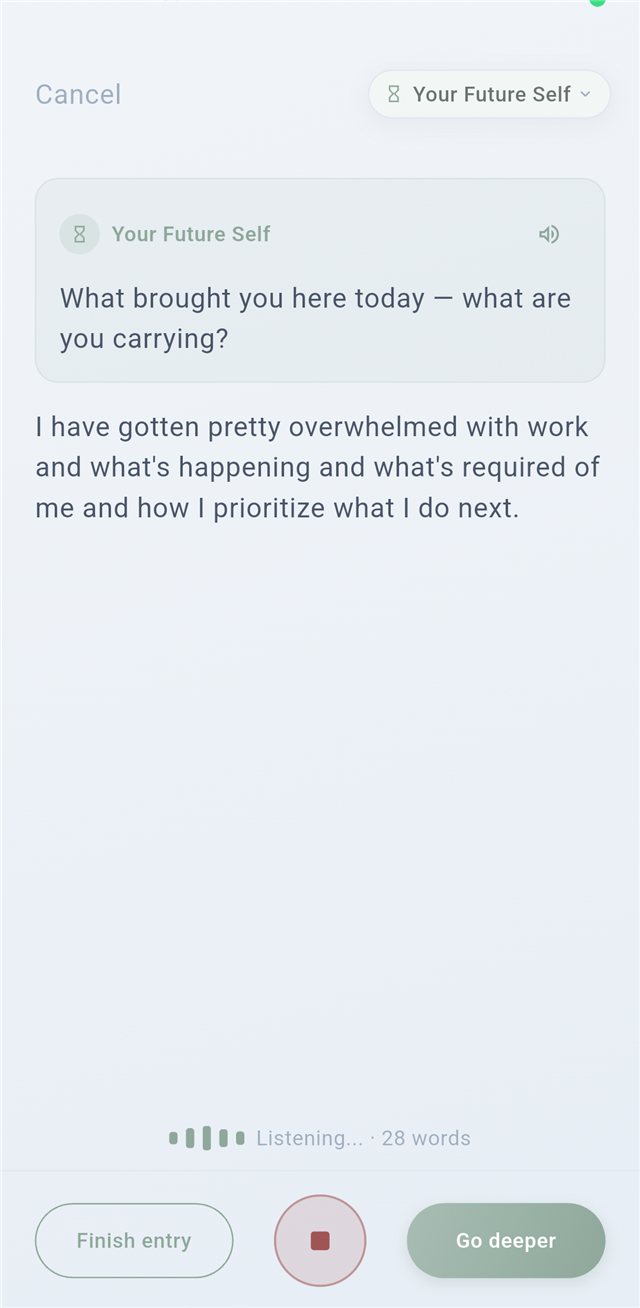
You open the app standing at the counter with wet hands, or lying on the bed with the lights off, and you just start talking. No prompt to invent yourself. No blank page waiting for you to organise the pile before you're allowed to begin. You pick a guide, say whatever's loudest first, and the guide asks the next question once that's out. You don't have to know what you need before you start talking. The storm doesn't have to be sorted before you're allowed to speak it.
Frequently Asked Questions
What are good journal prompts for overwhelm?
The prompts that work find one true, specific thing inside the pile rather than asking you to describe the whole pile. "What's the smallest true thing I know right now?" or "What can wait until tomorrow without anything breaking?" do more in ten seconds than a blank page does in ten minutes. Pick one prompt, say your answer out loud, and stop there if that's all you need.
Should I write or speak when I'm overwhelmed?
Speak, if you can. Writing needs you to sit down, pick up a pen, and follow one thread in order, which is exactly the sequencing overwhelm makes hard. Speaking works wherever you already are: standing at the counter, pacing a hallway, lying on the floor. Nagi is built around exactly this. You talk, a guide asks the next question, and a reflection comes back to you afterward.
How is journaling for overwhelm different from journaling for overthinking?
Overthinking is one thought circling without new information. Overwhelm is too many separate, legitimate demands arriving at once with nowhere to rank them. The fix for a loop is a sharper question that interrupts it. The fix for overwhelm is getting the whole pile out of your head fast, in any order, so you can actually see what's in it.