Someone makes an offhand comment in a meeting, not even aimed at you, and it lodges somewhere under your ribs anyway. You're still turning it over an hour later. The tone. The half-second pause before they said it. The look on your own face when you heard it. By the time you finally sit down to write it out, one feeling has become five, and the lined page in front of you has room for exactly one sentence at a time.
This is the specific way journaling fails a highly sensitive person. Not because you don't have enough to say. Because you have too much, arriving too fast, in no particular order, and the page asks you to pick one thread and follow it start to finish before you've even worked out which thread matters.
Why journaling for a highly sensitive person backfires before it helps
There's a real trait behind this, not just a mood. In 1997, psychologists Elaine and Arthur Aron named it sensory processing sensitivity: a nervous system that registers more from the same input and processes it more deeply than most people's do. Later estimates put high scorers at roughly 15 to 20 percent of the population. If that's you, a stray comment doesn't land as one data point. It lands as several at once: the words, the tone, the face, the memory it dredged up from three years ago, the worry about what it means for the relationship. All of it arrives together, in a pile, with nothing sorting it on the way in.
Writing asks for the opposite of a pile. One word, then the next, in order, until the sentence is finished and you can move to the next one. For a mind that's already holding five related feelings instead of one, that sequencing isn't the exercise. It's the obstacle. You're not bad at journaling. The format was built for a calmer kind of busy than the one you're actually carrying.
There's a second problem, and it shows up even when the format fits. A 2023 study in the journal Behaviour Change (Cambridge University Press) tracked people using a smartphone journaling app over time and found that the wellbeing gain only appeared for people who scored average or higher on a trait called dispositional self-reflection going in. Highly sensitive people tend to score high on exactly that trait. They already notice and turn things over. What's often missing isn't the willingness to reflect. It's a container fast enough to hold what's already happening before the reflecting can start.
The case for speaking it instead of writing it
There's a mechanical reason speaking works better here. Audiobooks are narrated at roughly 150 to 160 words a minute, and slide presentations run a touch slower, around 100 to 125. Handwriting, on average, moves at only about 13 words a minute. For most people that gap is a minor inconvenience. For a highly sensitive person already holding five feelings instead of one, it's the actual problem. Your hand can't move fast enough to keep up with what your nervous system already processed three sentences ago.
Speaking doesn't make you rank the five feelings before you're allowed to say the first one. It lets you start with whatever's loudest and clean up the rest afterward, if you even need to. (→ Journal Prompts for Overwhelm covers the same mechanism from a different angle: too much arriving at once, with nowhere built in to queue it.)
Nothing to sort first. Just say the loudest thing.
Free during the beta, on Android and iPhone.
Get early accessHow journaling for highly sensitive people can actually work
This is what Nagi is built for. You open the app and start talking, loudest feeling first, in whatever order it's actually arriving in. There's no blank page insisting you choose a throughline before you're allowed to begin. You pick a guide, ten are built in, from a steady Stoic voice to one that mostly just listens, and the guide asks the next question once the first feeling is out, instead of expecting you to have already sorted it yourself.
Nothing about being a highly sensitive person needs fixing here. The sensitivity is the whole reason you noticed what you noticed in the first place. The problem was never you. It was a format that assumed everyone processes at the same speed. (→ Journaling for Emotional Regulation goes deeper on why speaking moves feeling through the body in a way writing often can't.)
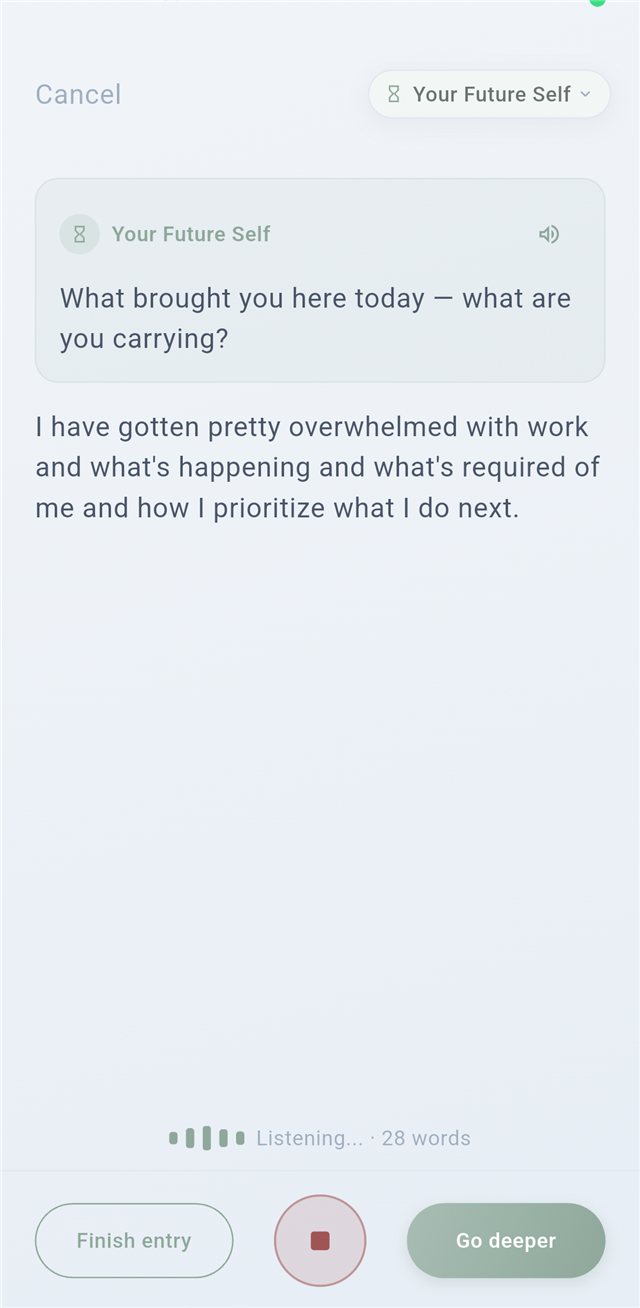
Journal prompts for highly sensitive people you can speak instead of write
Pick one. Say it out loud, even if you're the only one who hears it.
- What's the loudest feeling right now, before I try to name the rest?
- What did I notice just now that probably nobody else in the room did?
- Is this feeling about what actually just happened, or about something it reminded me of?
- What would feel like relief in the next two minutes, not the next two weeks?
- What am I carrying right now that actually belongs to someone else?
- If I didn't have to make this feeling smaller to be believed, what would I let it be?
- What does my body need right now: quiet, space, or just to finish saying this out loud?
- What's true about this moment that has nothing to do with how big it feels?
None of these ask you to sort the pile before you're allowed to speak. They ask you to find the loudest piece of it and start there. Everything else can wait its turn.
Frequently Asked Questions
What does journaling for a highly sensitive person actually look like?
Not a blank page and a pen, at least not as the starting point. A highly sensitive person is already processing more per moment than most journaling formats expect, so the thing that helps first is speed and sequence, not structure. Say the loudest feeling out loud, let a follow-up question find the next one, and let the page come after, not before.
Why does journaling feel overwhelming for highly sensitive people?
Because sensory processing sensitivity, the trait Elaine and Arthur Aron named in 1997 and later work estimated at 15 to 20 percent of the population, means more arrives per moment and gets processed more deeply. A single comment becomes several feelings at once. Writing demands one word at a time, in order, which is exactly the opposite of how the feelings showed up. The mismatch is the overwhelm, not a flaw in you.
Is speaking better than writing for a highly sensitive person?
Usually, yes. Handwriting averages around 13 words a minute, while speech moves several times faster. For someone holding multiple feelings at once, that speed gap is the difference between getting it out before it compounds and watching it pile up while your hand tries to catch up. Nagi is built around speaking first: you talk, a guide asks the next question, and a reflection comes back afterward.