Something goes wrong and your first move is to find a person. You call a friend on the walk home. You leave a voice note halfway through the thought. Lately, when there's no one awake, you open ChatGPT and start typing at it, not because you wanted a machine but because it was there and it helped you think. You've never sat down with a notebook and felt anything click. If that's you, you're a verbal processor, and the blank page was never going to stick.
There's nothing wrong with you for it. You think by talking. The clarity arrives in the saying, not before it. The whole time you've been told journaling is good for you, you were being handed a tool that asks for the one thing you can't produce on demand: a finished thought, written out, in order, before you've worked out what you mean.
What a Verbal Processor Actually Is
A verbal processor is someone who forms their thoughts by saying them aloud. The thinking and the speaking are the same event. You don't talk to report a conclusion you already reached quietly; you talk to reach it. The sentence comes out half-formed, you hear it, and the next sentence corrects it. That back-and-forth is how you get anywhere.
It helps to put it next to the other two ways people process. The internal processor works it out in their head and tells you the tidy version once it's done. The written processor reaches for a pen and finds clarity on the page. The verbal processor finds it out loud, in conversation or in a voice note or just talking to the empty car. None is better. They're different routes to the same place. The trouble starts when a verbal processor is handed a written processor's tool and told to try harder.
You can usually feel which one you are. If you've ever said "I didn't know what I thought until I heard myself say it," that's the tell. If a problem only loosens once you've talked it through with someone, that's the tell. The instinct to reach for a voice rather than a page isn't avoidance. It's your actual method.
Why the Blank Page Fails a Verbal Processor
Here's the mismatch, plainly. Writing asks you to commit a thought to the page in a clean line. But your thinking happens in the talking, so the page is asking you to finish before you've started. You sit there with the cursor blinking, waiting for a sentence that won't form, because the sentence was supposed to form by being spoken, and you've taken speaking away.
So the page becomes a test instead of a release. You feel the pressure to be articulate before anything is out. You write a line, read it back, decide it's not quite right, delete it. The editor switches on before the thought is even clear. For a verbal processor that's not reflection, it's a second job stacked on top of the feeling you came in to process.
And then you blame yourself. You bought the nice notebook. You meant to keep it up. It sits there, three entries deep, quietly confirming that you're undisciplined. You're not. You were using the wrong instrument for how your mind works. The discipline was never the problem. We unpick that guilt in more depth in our piece on journaling for overthinkers, and on why the blank page is the problem for ADHD minds too.
The Science: Why Speaking Carries a Verbal Processor Further
This isn't only a feeling. Speaking and writing make genuinely different demands on the brain, and the difference matters most for the kind of thinker who works things out in real time.
Research by Bourdin and Fayol (1994) found that producing language in writing places a heavier load on working memory than producing it by speech. When you write, your brain juggles spelling, sentence shape, and the order of ideas all at once, all before the thought is fully out. For a verbal processor, that extra load lands exactly where the thinking is trying to happen. Speaking drops the load. The thought leaves the moment it forms, and the bandwidth that writing would have spent is free for the actual reflection.
There's a second advantage to the voice. Kraus (2017), writing in American Psychologist, found that voice-only communication produced higher empathic accuracy than reading words alone, because the voice carries emotional information that text strips out. The pace, the catch in a sentence, the place you slow down. When you speak what's troubling you, more of the real emotional signal is present than when you flatten it into type.
None of this means writing is useless. The deeper, well-evidenced point is about putting an experience into language at all. James Pennebaker's work, across decades of studies, shows that turning an emotional experience into words and shaping it into a coherent narrative produces measurable gains in mood, physical health, and clarity (Pennebaker & Seagal, 1999). What matters is that you do it. For a verbal processor, the most natural and least costly way to do it is out loud. We put speaking and writing side by side in voice journaling vs writing if you want the full comparison.
How to Do Your Verbal Processing on Purpose
Most verbal processors are already processing constantly. The trouble is it happens by accident and nothing comes back. The walk where you sorted out the whole argument? Gone by dinner. The voice note that finally made the feeling make sense? Buried in a chat thread, never reread. The goal isn't to start a new habit. It's to point the habit you already have somewhere it lands.
Talk to a person, deliberately. The oldest tool there is. Tell a friend you don't need advice, you just need to think out loud at them for five minutes. It works. The limit is obvious, though, and you've already felt it: there's only so often you can be the friend who needs to process, and the guilt of asking again is real.
Speak into a voice memo, with intention. Open the recorder and say what's present, out loud, without stopping to edit. This gets the thought out of your head and into the air. The catch is that a voice memo only ever records. It never asks you anything back, so you tend to circle the problem rather than move through it.
Use a voice journal that replies. This is the version built for how you actually think: you speak, and something asks the next question. Not advice, not a transcript. The follow-up question that a friend would ask if they were free and a recorder never could. That question is what turns a vent into a reflection.
Voice Journaling: The Tool Built for Verbal Processors
For a long time the verbal processor had no real home. Voice memos don't listen. Friends aren't always free, and you know how often you've leaned on them. ChatGPT will talk back, but it drifts, it doesn't hold your history, and some part of you flinches at handing your most unguarded thoughts to a general model that wasn't built for this. Each option is missing one piece.
Voice journaling closes the gap, and it's exactly what Nagi is built around. You pick a guide, one of ten voices grounded in different frameworks, grounding, analytical, gentle, stoic, challenging, whichever fits the moment. Then you speak. The guide listens and asks the question you wouldn't have asked yourself, drawing you a layer deeper, and hands back a reflection in your own words. The storm goes in; something clearer comes out.
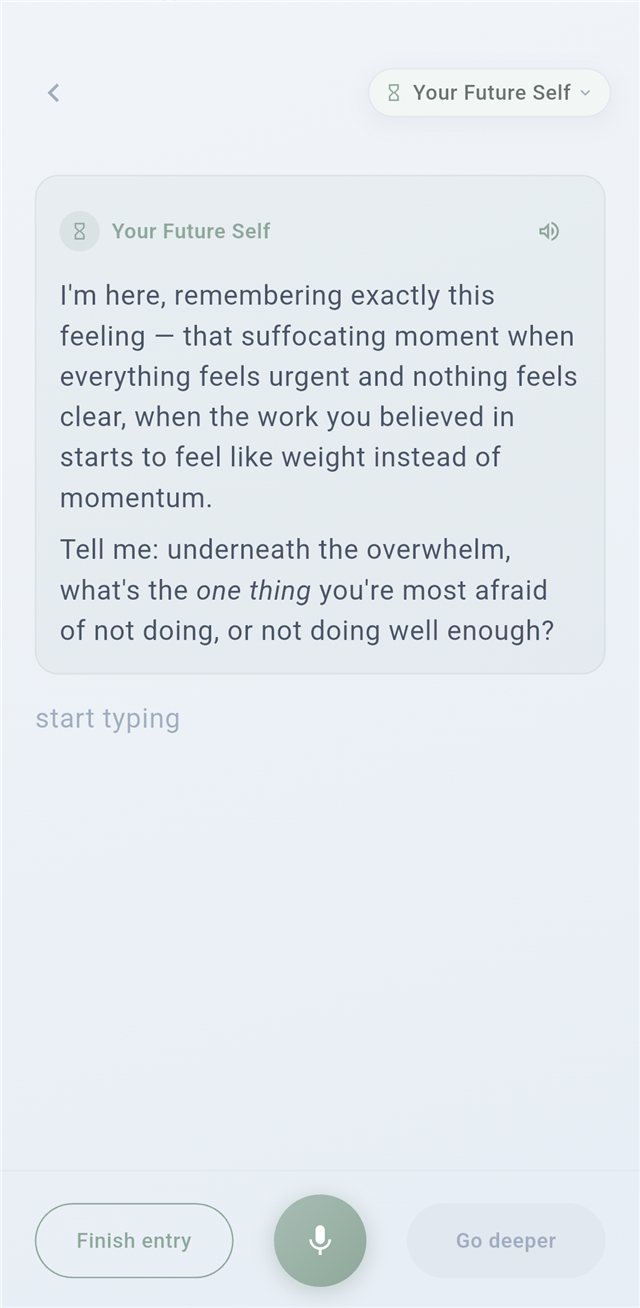
No blank page. No needing the right words first. No leaning on the same friend a fourth time this week. Just your voice, a guide who asks, and a reflection that comes back to you instead of evaporating. If you've spent years being told to journal and never once felt it fit, this is the version made for the way you already think. If the blank page is your specific sticking point, we go deeper on that here, and if you've bounced off polished journaling apps before, the case for a voice-first alternative is here.
Frequently Asked Questions
What is a verbal processor?
A verbal processor is someone who forms their thoughts by saying them out loud. The thinking happens in the speaking, not before it. Where an internal processor reaches clarity quietly in their head and a written processor reaches it on the page, a verbal processor reaches it in conversation, in a voice note, or simply by talking through the problem aloud. If you've ever said "I didn't know what I thought until I said it," that's verbal processing.
Why does journaling never work for verbal processors?
Because writing asks for structure before the thought is fully formed. A verbal processor's thinking happens in the act of speaking, so the blank page demands the one thing they can't supply yet: a clear sentence, in order, before they've worked out what they mean. The page becomes a test rather than a release. It isn't a discipline problem. It's a mismatch between how you think and the tool you were handed.
Is verbal processing a real thing or just an excuse not to journal?
It's real. Speaking and writing place different demands on the brain: research by Bourdin and Fayol (1994) found that producing language in writing carries a heavier working-memory load than producing it by speech. For someone who thinks as they talk, that extra load lands exactly where the thought is trying to form. Verbal processing isn't an excuse for avoiding the page; it's a description of where your clarity actually comes from.
How can a verbal processor process on purpose instead of by accident?
Most verbal processors already do it by accident, in voice notes to friends or talking to themselves on a walk. To do it on purpose, give the talking somewhere to land and someone to ask the next question. That can be a trusted friend, a voice memo you speak into deliberately, or a voice journaling app built to ask the follow-up. The structure is what turns circling into reflection.
What is the best tool for a verbal processor?
The most useful tool for a verbal processor is one that lets you speak freely and gives something structured back. A voice note records but never replies. A friend replies but isn't always free. Nagi is built for exactly this: you speak, a guide asks the next question and draws you deeper, and you walk away with a reflection in your own words. Nagi's free during the founding-member beta on iPhone and Android.